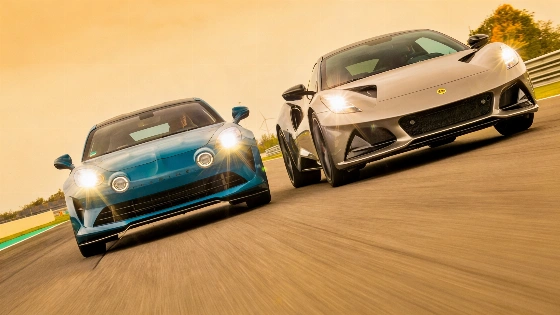
Alpine A110 GTS and Lotus Emira Turbo SE: A Duel of the Last Lightweight ICE Sports Cars. The Alpine A110 GTS and Lotus Emira Turbo SE are two rare sports cars featuring engines under 400 hp and weighing less than 1.5 tons. Both could be the last of their kind on the Spanish market. What are their key differences, and why does it matter for driving enthusiasts in Spain?
Amid the rapid global shift of the auto industry towards electric vehicles, the Alpine A110 GTS and Lotus Emira Turbo SE stand out as possibly the last representatives of classic lightweight sports cars with mid-engine layouts. According to Auto Bild, both cars combine powerful petrol engines—300 and 400 hp, respectively—with a mass not exceeding 1,500 kg, which is now a true rarity even in the sports coupe niche.
Lightness as a Philosophy
Alpine and Lotus have historically been associated with the idea of lightness and pure driving pleasure. For Lotus, this principle was established by Colin Chapman, while Alpine built its reputation on rally success and unique mountain road handling. Although both brands now belong to major automotive groups—Renault and Geely—they still retain an exotic status and cater to enthusiasts who value not only power, but also the balance of weight and dynamics.
In Spain, both models remain niche but notable players among true sports car enthusiasts. The A110 GTS, celebrating the brand's 70th anniversary, combines elements of the GT and S versions, offering sports suspension, leather, carbon and Alcantara trim, as well as an optional aerodynamic package and Akrapovic exhaust. Only 110 units of this version have been produced, highlighting its exclusivity on the market.
Technology and Equipment
The Lotus Emira Turbo SE, for its part, relies on a 400 hp AMG four-cylinder engine and an expanded Special Equipment package, which includes a sports suspension, 20-inch alloy wheels, perforated brakes, and an interior trimmed with Alcantara. Although the Emira is heavier than classic Lotus models (1,472 kg compared to around 1,000 kg for the Elise), it is positioned as a more versatile and comfortable sports car, while still maintaining the brand’s signature handling.
Inside, the Emira impresses with its level of finish: soft leather, premium Alcantara, and comfortable GT-style seats. However, not all design choices are unambiguous—the large gear selector panel and the start button cover are somewhat controversial. The Alpine A110 GTS, on the other hand, retains a more austere and sporty interior focused on functionality and minimalism, dominated by Alcantara and classic virtual instruments.
Performance and track behavior
On the race track, both cars reveal their strengths. The Emira Turbo SE features a stiff suspension and instant steering response, which is highly valued on the circuit but can be tiring in daily driving. The AMG engine sounds restrained at low revs but turns into a true soundtrack when accelerating aggressively. Thanks to launch control and grippy tires, the Emira accelerates to 100 km/h in 3.9 seconds, which is even faster than the claimed time and quicker than the Alpine (4.3 seconds).
The Alpine A110 GTS makes its mark with lower weight and livelier handling. On winding sections of the track, the French sports car proves to be more agile, allowing the driver to play with balance and trajectory. Its suspension permits more body roll, but this only adds to the sensation of lightness and control. At the same time, the Lotus has the advantage on straights, but its tires require time to reach optimal temperature, which affects lap stability.
Market prospects for Spain
Both cars remain niche offerings for the Spanish market, where demand for lightweight combustion-engine sports cars is gradually giving way to electrification. Nevertheless, such models still attract interest from collectors and enthusiasts, especially given their limited production runs and unique technical solutions. The future for these kinds of cars remains uncertain: both Alpine and Lotus have already announced their transition to electric platforms, and whether the lightness and driver-focused nature can be preserved in the new reality is a concern even for the most loyal fans.
In this context, the comparison between the A110 GTS and Emira Turbo SE becomes particularly relevant for Spanish car enthusiasts, who value not only power but also engineering philosophy. As with the rivalry between the Seat Ibiza and Peugeot 208, where nuances of practicality and electrification come to the fore, as discussed in detail in the article about the segment's key bestsellers, the fate of lightweight sports cars also depends on the balance between tradition and new technologies.
The Alpine A110 GTS and Lotus Emira Turbo SE are not just the last representatives of their class, but also mark the end of an era when lightness, pure mechanics, and driving pleasure were at the forefront. Their arrival on the Spanish market is a rare opportunity for enthusiasts to experience the full thrill of a classic sports car before the segment is completely transformed by new standards and technologies.