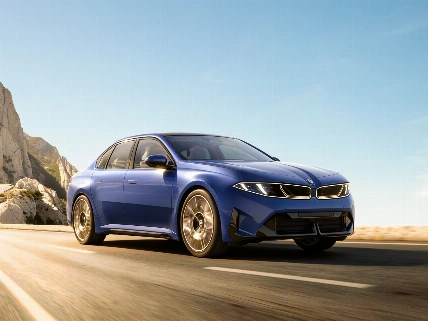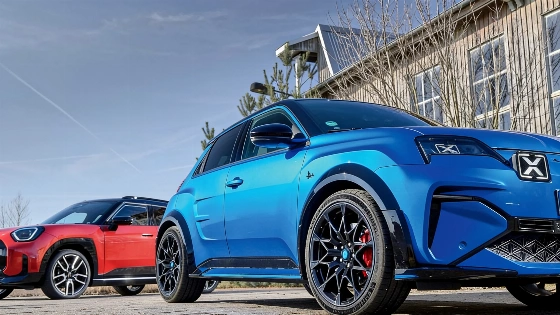
Alpine’s new A290 GTS and the Mini Aceman SE both promise 218 hp and the kind of urban agility that once defined the original Mini. Each is rated at 160 kW, though market specifications may express that output differently. Beneath the headline figure, these two electric hatchbacks take sharply different approaches to performance and personality.
Derived from the Renault 5 E-Tech platform, the Alpine A290 GTS has a clear mission: to recapture the playful, heart-stealing spirit that made the early Mini so iconic. Alpine gives the car its own styling and powertrain calibration, then develops the chassis separately from the Renault’s setup. The Mini Aceman SE, by contrast, leans into refinement, offering a more mature and composed experience while packing the same headline power.
Performance and Driving Feel
Despite identical power outputs, the nearly 300 kg difference in weight sets the tone from the first moment. The heavier, more subdued Mini Aceman SE accelerates with less urgency, its 330 Nm of torque tempered by mass. The lighter, more eager Alpine delivers sharper acceleration and a more visceral connection to the road, even though it sends 30 Nm less torque to its front wheels.
On the move, the contrast deepens. The Aceman SE glides with a calm, almost polished demeanor; its steering is precise, and its electric whir unobtrusive. The A290 GTS, by comparison, is restless and communicative: the steering tugs and the front axle squirms, with every input bringing immediate feedback. Even when lifting off the accelerator on rough roads, the Alpine feels alive, sometimes choosing its own line rather than following the driver’s every command. Yet its steering remains direct and reassuring, with just the right amount of electric assistance, true to its sporting intent. Alpine describes the A290’s intended character as “responsive, playful and accessible,” reflecting the balance sought through its performance and chassis tuning.
In corners, the Alpine’s playful chassis shines. Its Alpine-specific sport chassis works with hydraulic bump stops; Michelin Pilot Sport 5 tyres complete a setup designed to distinguish it from the Renault 5. It reacts more vividly to throttle changes and encourages aggressive turn-in, rewarding drivers who seek excitement. The Mini, meanwhile, feels safer and more grown-up, with less body movement but a tendency to understeer sooner, especially given its heavier front end. Both cars feature well-calibrated stability control and strong braking, stopping from speed in under 36 meters, a benchmark for this segment.
Range and Everyday Use
Real-world usability is closely matched, although their battery and range figures are not identical. The A290 GTS has a 52 kWh battery, while the Aceman SE is listed with a 49.2 kWh pack. Published figures put the Mini’s maximum range at 405 km on the WLTP cycle and the A290 at about 360 km in Japanese-market specifications. WLTP figures are standardized test-cycle estimates, not guarantees of real-world distance. Driving style and conditions affect range; wheel choice and market specification matter too. On the mixed route described here, the Mini edges ahead by 30 km, but neither will comfortably exceed 200 km when driven enthusiastically. Both average between 25 and 30 kWh per 100 km in the conditions described.
Charging times are nearly identical in the comparison: the Alpine charges from 15% to 80% in 30 minutes, while the Mini takes 31 minutes, starting from 10%. The Aceman SE supports DC charging at up to 95 kW, with a listed 10-80% charge time of about 31 minutes; the A290 has an 11 kW onboard AC charger. Alpine also says the A290 supports bidirectional charging, including vehicle-to-grid (V2G) and vehicle-to-load (V2L) functions, allowing the car to interact with the grid or power compatible external devices.
Interior and Comfort
Inside, the Mini Aceman SE opts for restraint. Its large circular display is highly configurable, but the head-up display feels less inspired. The Alpine A290 GTS, on the other hand, brings its playful character inside. A flat-bottomed steering wheel anchors the cabin, while the rotary mode selector and Formula 1-style recovery level adjuster add to the sense of occasion. Animated graphics accompany spirited driving, and the seats offer more lateral support, placing the driver lower and closer to the car’s dynamics.
Comfort, but, tilts in the Mini’s favor. Its seats are more generously padded, and the cabin is better insulated from noise. Rear passengers fare better in the Aceman, which offers more space for longer journeys, while adults will find the A290 GTS’s back seats cramped. The difference in practicality is reflected in their dimensions and luggage capacity: the Aceman is about 4.08 metres long and has a 300-litre boot, while the A290 measures roughly 4.02 metres in the cited Japanese-market specification. The Aceman is also listed with a 750 kg towing capacity.
Verdict
The Alpine A290 GTS is the sharper, more agile performer, quicker off the line and more engaging, but also pricier and less efficient. It stands out for pure driving fun. The Mini Aceman SE, meanwhile, is the all-rounder: more comfortable and practical, while only marginally slower, making it the more multifunctional choice for daily life.
For those considering other electrified options, the Mitsubishi ASX 180 HEV offers a different take on urban efficiency, blending hybrid technology with SUV practicality.
Both the Alpine and Mini show how far small electric cars have come, each carving out a distinct identity. The choice comes down to what matters more: raw excitement or everyday comfort.