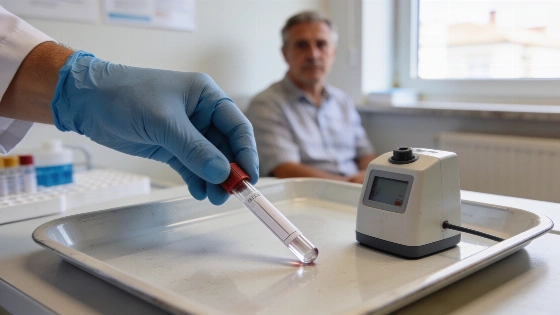
Blood tests can now find signs of Alzheimer's earlier, while new drugs can slow decline in selected patients. Spain has yet to approve public funding for either treatment.
Alzheimer's care is moving beyond waiting for memory loss to become disabling. Blood tests for p-tau217 and two new drugs are changing how doctors diagnose and treat the disease. The shift is already reaching clinical practice, even though Spain's Commission for Interministerial Prices on Medicines has issued a negative resolution on funding either therapy.
The change starts with a blood sample. For decades, confirming Alzheimer's often meant a lumbar puncture or a tau-specific PET scan. Both are expensive, invasive and hard to access.
In September 2026, the U.S. Food and Drug Administration authorised the first blood test for Alzheimer’s for adults aged 40 and over. The regulator says it is intended to help assess amyloid pathology alongside a clinical evaluation, not to provide a standalone diagnosis.
Research led by Lund University in Sweden with the Pasqual Maragall Foundation found that plasma p-tau217 identified amyloid pathology with 81% accuracy. A two-stage protocol uses the blood test first. Only positive cases then go on for imaging or cerebrospinal-fluid analysis. That cut invasive testing by more than 40% without reducing diagnostic reliability.
The laboratory result is becoming more than a simple yes-or-no answer.
Data presented at the 2026 International Conference of the Alzheimer's Association showed that blood p-tau217 was not inferior to amyloid PET when identifying Alzheimer's disease in people without symptoms. A JAMA study also linked higher concentrations to later decline. Patients with very high levels faced an absolute 38% risk of developing cognitive impairment within five years, compared with 24% among those with merely high levels.
The Alzheimer’s Association’s clinical recommendations for blood-based biomarkers in specialised care do not treat a blood result as a complete replacement for PET or cerebrospinal-fluid testing. The practical direction is a two-stage pathway: use blood testing to identify people who may need further assessment, while reserving more expensive or invasive confirmation for complex cases.
That is why the Alzheimer's Association has issued its first clinical practice guideline on blood biomarkers in Alzheimer's & Dementia. A relatively inexpensive test could be introduced in primary care. PET scans and lumbar punctures could then be reserved for cases that need confirmation. The FDA has also stressed that doctors must read a blood result alongside medical history, cognitive testing and a neurological assessment. Imaging or cerebrospinal-fluid analysis may still be needed.
Early detection matters because treatment has finally moved beyond managing symptoms alone. Lecanemab and donanemab are monoclonal antibodies aimed at beta-amyloid. They arrived after more than 200 medicines failed in phase III trials during two decades of therapeutic disappointment.
In the Clarity AD trial published in the New England Journal of Medicine, lecanemab reduced cognitive decline by about 27% after 18 months. The TRAILBLAZER-ALZ 2 trial published in JAMA reported a reduction of up to 35% with donanemab among patients with the lowest tau burden.
Neither medicine restores lost memory or cures the disease. Both slow progression only in people diagnosed at a very early stage. Both also require close monitoring because of ARIA, which can involve brain swelling or microhaemorrhages. The European Medicines Agency has authorised both drugs. Spain's pricing decision has drawn protests from the Sociedad Española de Neurología. As of September 2026, Spanish public financing for lecanemab and donanemab remains unresolved. Both are listed as not financed by resolution. Reports have put the potential annual cost at roughly €24,000-€32,000 per patient, alongside safety concerns.
The value of acting early becomes clearer when families spend years searching for answers, as shown in an earlier report. Alzheimer's research is now trying to shorten that period of uncertainty by combining screening with treatment before irreversible damage becomes dominant.
A third line of research looks at inflammation and metabolism. The phrase "type 3 diabetes" is not an official medical category. It describes the idea that the brain can become resistant to insulin, contributing to chronic low-grade inflammation and neuronal damage. The preventive steps are familiar: a Mediterranean diet, regular physical activity, control of weight and glucose, quality sleep, and sustained cognitive and social activity. Evidence cited in the source suggests that acting on these factors could delay up to 40% of dementia cases.
Newer studies are examining whether p-tau217 can help predict when cognitive decline may begin, rather than simply detect existing Alzheimer's-related pathology. A 2026 pooled analysis found that higher concentrations were associated with greater risk, particularly among people carrying the APOE ε4 variant. These results are meant for risk assessment and research selection, not precise predictions for individual patients.
Bill Gates wrote about his father's diagnosis on Gates Notes and described the helplessness of waiting for a cure. His father died in 2020. Six years later, Gates has taken a more optimistic view of Alzheimer's research. That optimism comes from the combination of blood biomarkers, disease-modifying medicines, metabolic research and artificial intelligence used in screening and trial design.
It does not mean Alzheimer's has been cured. It does mean doctors can treat the disease earlier, measure risk more precisely and give primary care a larger role. Until now, cost and invasive testing limited that role. For patients and families, the biggest change is simple: waiting for severe symptoms is no longer the only clinical strategy available.
La doctora María Isabel Tejeda González is an internist at Clínica Neleva.