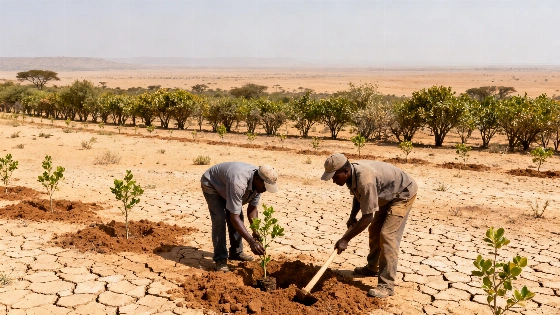
Africa Builds an 8,000 km 'Green Wall' to Halt Sahara's Advance. Eleven African countries are working to stop desertification by planting a massive belt of trees. The Great Green Wall project aims to restore soil fertility, create jobs, and protect families whose livelihoods depend on agriculture.
Along the southern edge of the Sahara, from Senegal to Djibouti, an unusual barrier—the Great Green Wall—has been under construction for almost two decades. It is not made of concrete or wire, but is a living strip of trees and shrubs designed to halt the southward advance of the desert and preserve millions of hectares of farmland.
The project was launched in 2007 at the initiative of eleven African countries. Its goal is to restore 100 million hectares of degraded land, capture up to 250 million tons of carbon dioxide, and create 10 million new jobs by 2030. In 2021, after an international meeting in Paris, the European Union, the World Bank, and the African Union joined in funding, allocating $14 billion to accelerate the work.
Practical value
For the residents of the Sahel—a region where land is rapidly losing fertility—the success of the Green Wall is a matter of survival. If the soil becomes depleted, families lose their harvests, income, and ability to remain on their land. Restoring soil fertility not only revives agriculture, but also improves food security, offers employment opportunities for young people, and reduces migration risks.
A single green hectare can capture up to 500 tons of CO2 and feed several families. This is why the project is seen as a key tool in combating climate change and poverty in the region.
Tangible successes and challenges
Despite ambitious goals, the pace of implementation lags behind plans. According to the African Union, only about 18% of the work has been completed so far. However, some countries are showing notable progress. Ethiopia has restored 15 million hectares, not only through new plantings but also by protecting young native trees and combating illegal logging. Senegal has planted 12 million trees, and Nigeria has restored 5 million hectares in the north of the country.
These achievements allow some farmers to maintain crop yields for longer, but the scale of the problem remains immense. According to the UN, more than 135 million people in the region depend on degraded land, and the desert advances by 45–60 centimeters each year. Over the past decades, the temperature in the project area has risen by 1.5°C—faster than the global average.
Difficulties and risks
The implementation of the 'green wall' faces corruption, water shortages, political instability, and weak control over fund allocation. As NPR points out, a portion of international investments was lost due to inefficient management and government coups. In some areas, planting is progressing slowly or has not started at all.
If the situation does not change, up to 250 million people could be forced to leave their homes by 2050 due to land loss and worsening climate. That is why, for Sahel countries, the project remains not only an environmental but also a social challenge, with the future of entire generations at stake.
According to Talent24h, the 'Great Green Wall' is one of the largest and most challenging environmental projects of our time. Its success depends not only on funding, but also on the ability of countries to cooperate, combat corruption, and address the real needs of local communities.