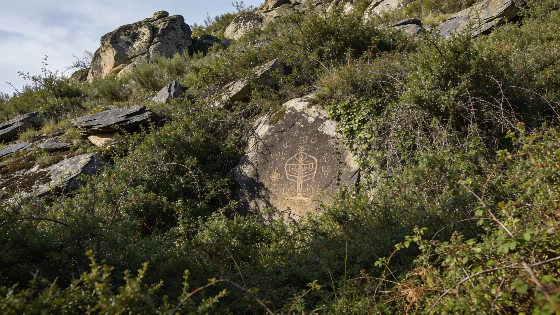
Millennia-old engravings at La Salud in Salamanca remain vulnerable. Official promises of restoration and protection have yet to materialize. The site’s fate now hinges more on wild undergrowth than on institutional action.
Repeated promises to protect Salamanca’s prehistoric rock art have come to little, leaving the Paleolithic engravings and paintings at La Salud exposed to vandalism and neglect. Despite its status as a Bien de Interés Cultural, the site’s main defense is the thick, wild vegetation that keeps most people away.
La Salud sits on the edge of Salamanca, next to the Tormes river. The 88-hectare site holds geometric shapes, animal figures, and human forms carved and painted up to 25,000 years ago. Official protection exists mostly on paper. The only visible effort is a fence around one ancient carving; the rest is hidden under brambles and fallen wires.
La Salud is officially recognized as a Bien de Interés Cultural, a legal status intended to guarantee heritage protection in Spain.
Reaching the engravings is difficult. Visitors have to push through thick brush, climb down slippery slate, and pass makeshift huts and the remains of an old powder magazine. The site’s inaccessibility, not any real municipal or regional effort, is what keeps vandals out for now.
Local heritage advocates, including Jesús Delgado from Ciudadanos por la Defensa del Patrimonio, have criticized the authorities for doing little. Delgado warns that the overgrown site is a fire risk and says it is safer not to share the exact location, since one careless visitor could cause permanent damage.
There have been many official statements, but little action. In 2023, Salamanca’s mayor, Carlos García Carbayo, announced a €3 million plan to develop the site for tourism, aiming for completion in late 2024. By May 2025, the city council said the Confederación Hidrográfica del Duero had finally approved protective fencing, a year after the request. The landowner, Fundación Apóstol Santiago, was said to be ready to start the work, after which the Junta de Castilla y León would begin cleaning and restoring the vandalized art. So far, only a reinforced barrier around a two-headed horse engraving has been installed.
According to official communications, the Confederación Hidrográfica del Duero only granted permission for protective fencing in 2025, despite the request being submitted a year earlier. This delay has contributed to the ongoing vulnerability of the site.
The Junta, which grants the BIC status, has not taken any major preservation steps. A spokesperson from the regional Culture department says their intervention is finished and that no new projects have been submitted for approval. Meanwhile, city officials say fencing and protection are underway, waiting on the landowner’s next move.
Experts are doubtful. Retired prehistory professor Julián Bécares, who knows the site well, says opening La Salud to the public without a solid protection and interpretation plan would be risky. Even experienced visitors often turn back because of the rough terrain. Bécares believes that until there is real commitment to conservation and education, it is better to keep the site discreet. With proper investment, he says, La Salud could one day compare to Siega Verde—another Paleolithic site in Salamanca province that is a World Heritage Site, though La Salud is smaller.
Scientific research highlights the site’s value. A 2016 study by University of Salamanca researchers documented four animal figures—two horses, a cervico-dorsal line, and a possible goat—along with abstract motifs. The authors warned that erosion and rockfall had already destroyed parts of the art, and that what remains is similar to more famous sites. They called for urgent study and protection, but little has changed since then.
While authorities debate and delay, the fate of La Salud’s ancient art depends on nature and luck. This situation is not unique: in other cases, environmental barriers, not official action, have become the last defense for Spain’s heritage. As reported earlier, official inaction can leave even landmark sites at risk, regardless of their legal status.
Spain’s record on heritage protection is uneven. Some sites get world-class care and international attention, while others are left to chance. La Salud is another example: big announcements, little follow-through, and a reliance on wild growth to keep the past safe. Until authorities move from words to real, lasting action, the country’s prehistoric legacy will stay at risk from both time and neglect.