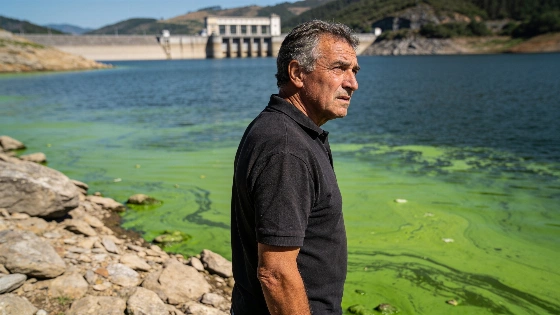
Toxic contamination in the As Conchas reservoir has now reached Portugal. Despite a landmark court ruling, authorities have failed to act. Residents demand urgent enforcement as health and water rights remain at risk.
Green, toxic water now stains not just the Galician reservoir of As Conchas, but also the Portuguese Lindoso dam downstream. One year after Spain’s highest courts condemned the Xunta and the Confederación Hidrográfica del Miño-Sil y Limia (CHMS) for violating fundamental rights, the authorities’ inaction has allowed the pollution to cross borders, sparking anger on both sides of the river Limia.
The legal fight began when the Tribunal Superior de Xustiza de Galicia (TSXG) ruled in July 2025 that regional and national administrations had failed to protect the right to life, privacy, property, and access to clean water for communities near As Conchas. The Supreme Court confirmed the decision in early 2026, stating the environmental disaster was not accidental but the result of years of neglect, despite clear evidence of harm from industrial livestock runoff.
В 2024 году ассоциация жителей As Conchas из Галисии официально обратилась к португальским активистам по поводу загрязнения воды в районе Lindoso, что подтвердило трансграничный характер проблемы.
This June, as temperatures rose, the reservoir’s surface turned a vivid, unnatural green again. The cause is clear: runoff from around 400 pig and poultry farms continues to flow into the Limia basin, fueling toxic cyanobacteria blooms. The contamination has now reached Portuguese territory, with the Lindoso dam showing the same symptoms. The cross-border spread has pushed the issue into the political spotlight in Lisbon, where both government and opposition are demanding answers from Galicia.
Local residents, represented by their association and supported by CECU, ClientEarth, and Amigas de la Tierra, have returned to the TSXG. They are now asking the court to force authorities to carry out its ruling, after officials failed to take meaningful action. So far, the only reported steps—paying court-ordered compensation, occasional farm inspections, and water sampling—fall short of what the judgment requires: stopping environmental damage, restoring safe water, and protecting basic rights.
The residents also want A Limia declared a nitrate-vulnerable zone and a halt on new or expanded industrial livestock operations until the crisis is resolved. Their legal team points to the ongoing toxic algae, persistent odors, and evidence of downstream contamination as proof that public health and the environment remain at risk. Delaying enforcement, they argue, only increases the danger and prolongs the violation of residents’ rights.
По данным местных СМИ, большинство публикаций о Lindoso в последние годы касались туристических аспектов и засухи, а не юридических споров или загрязнения. Однако в 2024 году в публичном пространстве появились сообщения о визитах и контактах между жителями Галисии и португальскими активистами, что свидетельствует о растущем общественном интересе к трансграничному загрязнению воды.
Spanish courts have cleared local municipalities of direct responsibility but ordered the Xunta and CHMS to act immediately. The ruling set out specific obligations: environmental and health studies, permanent water quality monitoring, public information systems, and real steps to reduce livestock pressure on the Limia basin. Residents now want the court to set deadlines, assign responsibility, and require regular progress reports to make sure the orders are actually followed.
As the toxic blooms reach Portugal, the As Conchas case has become a warning for other Spanish regions facing similar threats from industrial agriculture. The situation is another example of cross-border environmental risks that have led to joint responses in other areas, such as the recent storm naming agreement between Spain and its neighbors.
The gap between clear court rulings and real action stands out. The courts have spoken, but political will to challenge the powerful livestock industry is still missing. Until authorities move beyond token gestures and enforce real change, the rights of people living along the Limia—and now across the border—remain unprotected. This is no longer just a local dispute, but a test of whether environmental justice in Spain can overcome entrenched interests and bureaucratic inertia. The longer officials wait, the more communities pay the price for their inaction.