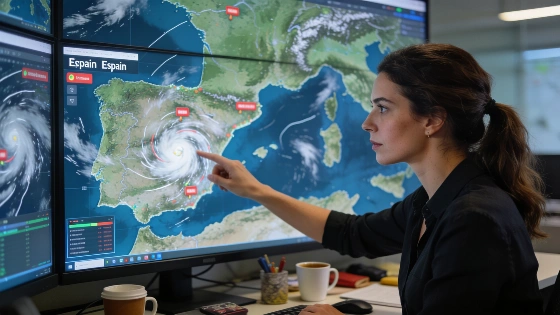
Spain and five European countries have set the official list of 21 names for major storms and danas in 2026–2027. The naming system aims to improve public alerts and cross-border coordination.
Spain, together with Portugal, France, Belgium, Luxembourg and Andorra, has finalised the new list of 21 names for storms and danas that could impact the region from September 2026 to September 2027. The updated roster, ranging from Adam to Walter and including names like Vera and Rafael, will be used to identify severe weather systems expected to bring strong winds or heavy rainfall across southwestern Europe.
This marks the tenth consecutive year that the Southwest European Group, which now includes Andorra’s Servei Meteorològic Nacional, will assign names to storms and, since last year, to danas—isolated high-altitude depressions known for triggering intense rainfall. The list is agreed in advance by all participating meteorological agencies, including Spain’s Aemet, Portugal’s IPMA, France’s Météo-France, Belgium’s RMI and Luxembourg’s MeteoLux. Names alternate between male and female, following the model used for hurricanes in the United States, and are selected to be easily pronounced in all group languages. Some letters, such as Q and U, are excluded due to the lack of suitable names.
Not every storm or dana receives a name. Only those systems forecast to cause significant impact—requiring orange or red alerts for wind, rain or snow over large areas—are included. For wind events, orange (important risk) or red (extreme danger) warnings must be issued. For rain or snow, orange and/or red alerts are needed, sometimes combined with yellow wind warnings. In the case of danas, which rarely bring strong winds, only rainfall criteria apply. The aim is to ensure that only the most dangerous weather events are named, helping authorities and the public to focus on the most serious threats.
The naming system is designed to make communication clearer during severe weather, aiding both emergency response and later analysis. The approach has proven effective in recent years, with the 2025–2026 list ending at Therese, named by Portugal in March, and two names—Vitor and Wilma—remaining unused. Unlike the Atlantic hurricane list, the Southwest European list has never been exhausted in a single season.
Names reflect the linguistic diversity of the participating countries, with options like Flora, Gabriel, Julia, Lola, Rafael and Vera from Spanish, Adam, Heloise and Nathalie from French, Bruna from Catalan, and Igor, which is common in the Basque Country. The selection process aims for inclusivity and ease of pronunciation across all languages involved.
Spain, France and Portugal began naming storms in 2017, starting with Ana. Since October 2025, the system also covers high-impact danas. The cost of naming a storm through the University of Berlin’s parallel system is €199, while naming an anticyclone costs €299, with proceeds supporting meteorological research. This can sometimes result in the same weather system having different names in different parts of Europe, as the University of Berlin allows citizens to sponsor names for all cyclones and anticyclones since 1954.
Besides the Southwest European Group, five other naming groups operate across Europe, each with its own procedures. The system is part of a broader effort to improve public safety and scientific tracking of severe weather. For context, Spain has recently experienced unusual weather patterns, such as the sharp temperature drop in Madrid last August, when a polar air mass brought the coldest day in decades—a situation detailed in this report on Madrid’s record low August temperatures.
The annual list of storm names is a practical tool for meteorologists, emergency services and the public, ensuring that major weather events are clearly identified and communicated across borders. As climate patterns continue to shift, the coordinated approach to naming and alerting remains a key part of Europe’s response to severe weather risks.