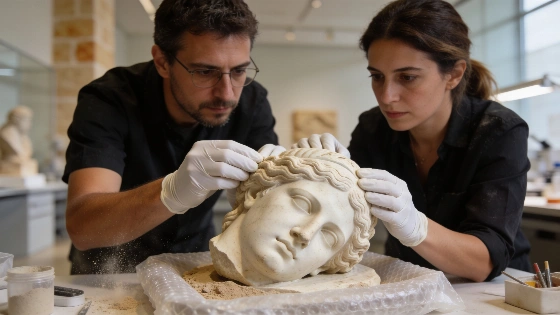
A marble head believed to depict Venus was discovered near Alicante’s Almadraba beach. The find, dating to the Roman Empire, has sparked political debate and questions over its handling.
A routine municipal canalization project near Alicante’s Almadraba beach took an unexpected turn when workers uncovered a marble head, later identified as a Roman-era depiction of Venus. The artifact, estimated to be around 2,000 years old and weighing 14 kilograms, was found just 50 meters from a known archaeological site. Its discovery has quickly become a focal point for both local pride and political controversy.
The marble head, measuring over 22 centimeters in height, was unearthed on May 11 during excavation works intended to regenerate the beach area between Albufereta and Cabo de las Huertas. Workers initially mistook the object for debris among stones and discarded bottles, but halted operations upon realizing its significance. The artifact was hastily wrapped in bubble wrap and placed in a supermarket bag for safekeeping before being transferred to the authorities.
Two weeks after the find, Alicante’s city council publicly announced the discovery, dubbing the piece the “Venus of Alicante” and dating it to the 1st or 2nd century AD, during the height of the Roman Empire. However, confusion over the exact date of the find and the handling of the artifact led to criticism. The city’s culture councillor, Nayma Beldjilali, initially gave an incorrect date on social media, later correcting it after political groups demanded clarification. Opposition parties, including Esquerra Unida and Compromís, have called for detailed explanations and formal recognition for the workers who made the discovery.
The marble head is currently undergoing cleaning and preliminary analysis at the Museum of Contemporary Art of Alicante (MACA). Experts, including José Miguel Noguera from the University of Murcia, have confirmed its authenticity and believe it was once part of a life-sized statue, likely representing the goddess Venus. The hairstyle and craftsmanship are consistent with similar Roman sculptures found in other parts of Spain, such as Tarragona and Cartagena.
According to municipal heritage officials, the artifact was found in a disturbed soil layer, lacking clear archaeological context. The area is adjacent to the ancient Roman settlement of Lucentum, where previous finds have included ceramics, coins, amphorae, and oil lamps. The marble used for the head is thought to have been imported from Greece or Carrara, indicating it belonged to a wealthy Roman household.
The city council has initiated disciplinary proceedings against the construction company for failing to notify the supervising archaeological firm before opening the trench. Despite this, officials have praised the workers for stopping the excavation in time and reporting the find. The artifact has since been moved between several municipal locations for cleaning, study, and eventual public display.
The final decision on the Venus’s permanent location will be made by the regional heritage authorities. In the meantime, plans are underway to exhibit the sculpture to the public and produce three replicas. The discovery has also prompted questions about the management of cultural heritage in Spain, echoing broader debates about transparency and recognition, as seen in other recent high-profile cases such as the scrutiny over political figures’ assets, including the recent controversy involving former Prime Minister Zapatero’s jewelry.
Roman remains are not uncommon along Spain’s Mediterranean coast, but the accidental unearthing of such a well-preserved marble head outside a formal excavation is rare. The find highlights ongoing challenges in balancing urban development with the protection of archaeological heritage. As the Venus of Alicante awaits its final placement, the city faces renewed attention on how it manages and celebrates its ancient past.