The Andalusian government will pay €7.4 million for Catholic chaplains in public hospitals. Critics call the move wasteful amid healthcare strain. The agreement renews a decades-old arrangement with the Church.
The Andalusian government has signed a new agreement with the Catholic Church to fund 117 chaplains in public hospitals, committing €7.4 million over the current legislative term. The deal, finalized just days after the last regional elections, will see annual payments of €1.8 million until 2030, continuing a practice that began in 1986. This decision has sparked strong criticism from healthcare advocacy groups and secular organizations, who argue that the funds should instead address urgent needs in the region’s strained health system.
Both Marea blanca and Andalucía Laica have condemned the renewed funding as an “insult to the public,” especially given the ongoing challenges in Andalusia’s healthcare sector. They point to overloaded emergency services, staff shortages, and growing waiting lists as evidence that the money would be better spent on hiring medical professionals. The groups also argue that the agreement contradicts Spain’s constitutional commitment to secularism, noting that only 17.4% of Spaniards identify as practicing Catholics, according to recent CIS surveys.
José Antonio Naz, president of Europa Laica, highlighted the historical roots of these agreements, which trace back to the 1953 Concordat between Spain and the Vatican and were later adapted for Andalusian hospitals. He warned that maintaining such arrangements perpetuates outdated privileges for the Church, especially in a country where nearly 40% of the population reports having no religion. Naz also linked the persistence of these agreements to broader ideological trends, referencing the influence of national Catholic traditions and the current political climate.
Healthcare advocates argue that the government’s priorities are misplaced. Sebastián Martín, spokesperson for Marea Blanca, criticized the decision to expand religious services while public health and preventive care are underfunded. He questioned the relevance of chaplains in a medical setting, comparing their presence to installing bank offices in hospitals to solve patients’ financial issues. Both organizations are demanding the immediate cancellation of the agreement, redirecting the €7.4 million to staff recruitment and waiting list reduction, and strengthening clinical psychology services, which remain under-resourced in Andalusia compared to national and European averages.
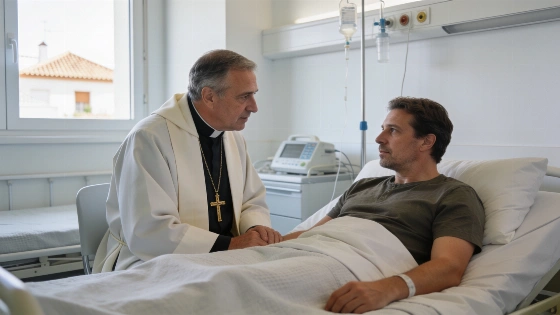
Inside the Virgen del Rocío hospital in Seville, one of the region’s largest, five Catholic chaplains currently serve patients and staff, despite the agreement stipulating seven and a half full-time positions. The chaplains’ duties include visiting patients, supporting healthcare workers, and providing spiritual care during illness and bereavement. Payments for these roles are made directly to the Church, with full-time chaplains receiving €18,496 annually from the regional government. The hospital’s chaplains share a small office and typically visit around 22 patients per shift. According to one chaplain, demand for religious support remains high among patients, regardless of official statistics on religious practice.
The regional government defends the agreement by citing its long-standing nature and notes that similar, though unpaid, arrangements exist with the Evangelical Church since 2011. However, the Evangelical agreement does not involve any financial compensation. The government also clarifies that chaplains are employed by the Church, not the health service, and are required to provide proof of a clean criminal record, particularly regarding sexual offenses, before working with patients.
As the debate continues, the issue of public funding for religious services in healthcare remains contentious. The controversy in Andalusia echoes broader national discussions about the role of religion in state institutions and the allocation of public resources. Similar tensions have surfaced in other regions, such as Valencia, where recent policy changes by the PP and Vox have also drawn criticism for prioritizing ideological measures over social spending. For example, recent reforms in Valencia have tightened access to social aid and introduced tax cuts favoring higher earners, sparking debate over government priorities.
Spain’s constitution enshrines the principle of state secularism, but agreements with religious organizations remain embedded in various public services. In Andalusia, the renewed funding for Catholic chaplains highlights the ongoing tension between tradition and calls for a more secular, needs-based approach to public spending. The outcome of this debate may influence future policy decisions not only in Andalusia but across Spain, as regions grapple with balancing historical agreements and contemporary demands for healthcare investment.