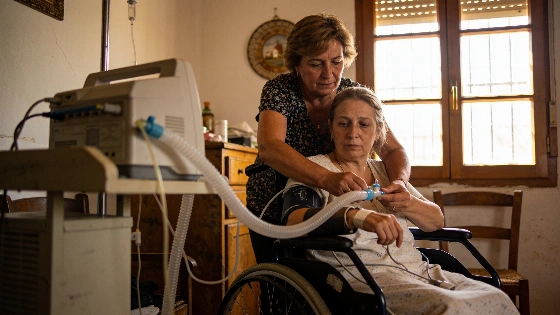
Dozens of Andalusians with advanced ELA are still waiting for promised financial aid. The regional government cites administrative hurdles, while families struggle with mounting care costs. The delay persists despite a national funding deal.
Severely ill ELA (ALS) patients in Andalusia remain without the financial support approved at the national level, as the regional government has yet to deliver payments months after the state agreement. Families report repeated attempts to obtain assistance, with some waiting since April, while the disease continues to progress. The situation has left many feeling abandoned by the system, as daily care needs become overwhelming and unaffordable without external help.
The delay affects dozens of applicants across the region, even though the Council of Social Services established the aid pathway nearly nine months ago and set eligibility criteria eight months back. The promised monthly support ranges from €3,200 to €9,850, but so far, no patient in Andalusia has received funds. According to ELA Andalucía, a handful of families have recently been contacted by the regional government and expect payment soon, but the majority remain in limbo.
Andalusia is not alone in this backlog. Similar delays are reported in Aragón, Navarra, Canary Islands, Balearic Islands, and Murcia, as confirmed by the national confederation ConELA. The administrative process is described as burdensome, with families required to submit extensive documentation and endure long waits, fueling frustration and uncertainty about whether payments will be made retroactively.
Spain has around 4,000 ELA patients, with approximately 750 in Andalusia. Following a unanimous vote in Congress, €500 million was allocated to support those with the most severe forms of the disease. The Ministry of Social Rights provides €4,930 per patient monthly, with regions expected to supplement the rest. Some regions, such as Catalonia, La Rioja, and Navarra, have set higher aid ceilings, reflecting the high cost of 24-hour care, which ConELA estimates at €14,000 to €18,000 per month.
The Andalusian government claims it has started processing payments but has not disclosed how many patients have benefited or the average amount granted. Officials point to the lengthy development of the national law and highlight that Andalusia introduced its own temporary aid in June 2025, resolving nearly 190 applications and distributing over €2.3 million. However, these regional grants, capped at €14,400 annually, fall far short of the estimated minimum care costs for the most severe cases.
Administrative bottlenecks persist, particularly in linking economic aid to home care services. Challenges include finding accredited providers, securing specialized staff, and navigating contract oversight. The government reports 54 resolved cases but acknowledges ongoing obstacles to effective payment delivery.
ConELA criticizes the slow pace in Andalusia and five other regions, stressing that time is critical for patients whose condition can deteriorate rapidly. While some communities, such as Valencia and Castilla y León, have accelerated their response, Andalusia has yet to confirm any completed payments. The confederation notes that 20–30% of the most severe patients ultimately request euthanasia, unable to cope with the lack of support and the high cost of care.
To qualify for the highest level of aid (grade III+), ELA patients must meet strict criteria, including advanced immobility and dependence on ventilatory support. The law allows for a means-tested copayment, which can reduce the maximum subsidy by up to 40% based on family income. While Madrid initially announced such a copayment, it reversed the decision after public backlash.
Caregivers highlight the strain on families, noting that hospitalizations for these patients are often more expensive than home care. The system requires families to act as employers to hire caregivers, adding another layer of complexity. The broader context of Spain’s healthcare challenges is reflected in other regions as well, as seen when Ceuta’s health services faced severe pressure following a sudden influx of migrants.
Spain’s approach to ELA care is shaped by the 2006 Dependency Law, which aims to guarantee support for those with severe disabilities. However, the gap between legal rights and practical access remains wide, especially in regions where administrative delays persist. The ongoing situation in Andalusia underscores the urgent need for streamlined processes and adequate funding to ensure that the most vulnerable patients receive timely assistance.