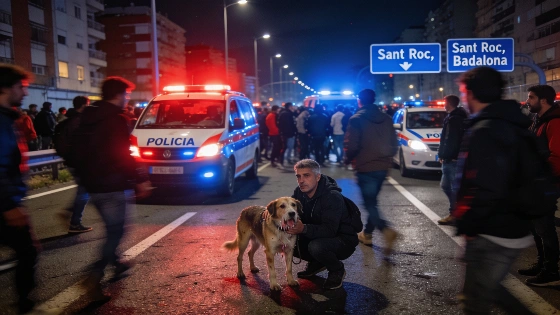
Badalona’s Sant Roc district was thrown into chaos on Wednesday night after a suspected case of animal cruelty escalated into a violent confrontation and major traffic disruption. It began on Alfonso XII Street, where witnesses say a dog started barking at a group of people. The animal’s owner, identified as a migrant from sub-Saharan Africa who still lives in the area after the former B9 block was evicted, was seen striking the dog in public, prompting immediate outrage from local residents.
Information from people at the scene, the situation escalated when the dog was reportedly incited against several minors, sparking a heated argument between groups. The dispute quickly spiraled out of control and became a mass brawl that spilled onto the C-31 highway. Dozens of residents moved to block the road in both directions between Sant Roc and Sant Adrià de Besòs, halting traffic for nearly an hour and raising fresh concerns about neighborhood safety.
Police responded quickly, sending multiple Mossos d'Esquadra patrols to the scene. Reinforcements arrived to restore order, while the regional emergency medical service (SEM) sent an ambulance as a precaution. The blockade was lifted around eleven o’clock at night, but the unrest exposed deep tensions in the area after recent evictions and amid ongoing disputes over public safety.
The roots of those tensions include the eviction of the former B9 institute, a municipal property in Sant Roc occupied since 2023. Around 400 people, most described as migrants from sub-Saharan Africa, had been living there before the police-backed operation on 17 December 2025. The Mossos d'Esquadra took part alongside the Policía Nacional and the Guardia Urbana; reports cited approximately 15 arrests and nearly 200 people identified. The city planned to demolish the property.
Barcelona’s Administrative Court No. 11 authorized the municipality to recover the building in a resolution issued on 12 December 2025. The High Court of Justice of Catalonia later upheld the authorization and rejected an appeal by 11 former residents. The eviction also prompted a separate legal and political dispute over accommodation and public services for former residents.
After the incident, Badalona’s mayor, Xavier García Albiol, said on social media that he had instructed authorities to identify the person responsible for the alleged animal abuse. Albiol described the suspect as “without papers” and linked to the group of migrants still present after the B9 eviction. He said such individuals “should be in a CIE” rather than on the streets. He has defended the eviction as lawful and rejected accusations that it was motivated by racism or xenophobia. The Mossos d'Esquadra have opened an investigation to establish the sequence of events and determine responsibility for the suspected animal cruelty and the disturbances that followed, including the highway blockade.
In a separate development linked to the B9 eviction, prosecutors archived a hate-crime complaint against Albiol. Promoted by the Comuns and involving European Parliament member Jaume Asens, the complaint alleged discriminatory denial of public services. It also accused Albiol of a hate crime, disobedience and administrative prevarication. Prosecutors concluded that the facts did not establish a hate crime or discriminatory conduct by the mayor. Reported on 20 October 2026, that decision concerns the eviction dispute.
Police sources say efforts are underway to identify those involved in the protest that blocked the C-31. Officers are collecting witness statements and reviewing video footage from the scene. The events in Sant Roc echo broader debates in Spain about public safety and migration, as well as local authorities’ responsibilities in managing social tensions. Similar incidents involving animals and public disorder have drawn national attention in recent years, including the high-profile bull run in Pamplona, which also raised questions about safety and law enforcement, as reported in coverage of the San Fermín festival.
Badalona, in the Barcelona metropolitan area, has faced repeated challenges involving housing and migration, alongside concerns about social integration. The Sant Roc neighborhood, in particular, has been at the center of high-profile disputes, including the B9 eviction and its aftermath. The latest unrest highlights the difficulty of balancing community safety with the rights and needs of vulnerable populations. Local authorities face pressure to address both the immediate fallout and the wider social tensions affecting the area.