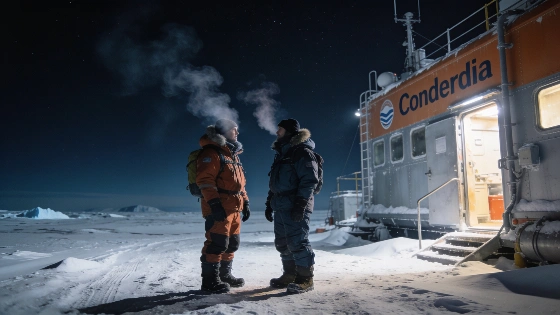
On July 18, 2026, the Concordia research station in Antarctica registered -84.1°C, one of the lowest air temperatures on Earth in recent years. The base’s remote location and harsh winter conditions leave scientists cut off from the outside world for months, highlighting the challenges of polar research.
At 6:25 a.m. on July 18, 2026, thermometers at the Concordia research station in Antarctica dropped to -84.1°C, marking one of the coldest air temperatures recorded on the planet in over a decade. Just nine minutes later, the same reading was confirmed again. For the international team stationed more than 1,000 kilometers from the nearest coast, this figure is not just a number—it defines the reality of life and work in one of Earth’s most inhospitable environments.
Concordia sits atop the Antarctic plateau at over 3,200 meters above sea level, where the sun disappears for months during the austral winter. The combination of high altitude, extreme dryness, and cloudless skies creates conditions where heat escapes rapidly into space, allowing temperatures to plummet far below what most of the world ever experiences. Even in a place accustomed to brutal cold, dropping below -84°C is rare and notable, as Italian station coordinator Gabriele Carugati explained. The reading is just shy of Concordia’s own record of -84.7°C set in 2010, and still some way from the world record of -89.2°C measured at Vostok station in 1983.
These extremes are not just numbers on a chart—they shape every aspect of daily life at the base. During the polar night, flights are impossible and the nearest neighboring station is 600 kilometers away. For months, the scientists and support staff are completely isolated, earning them the nickname “ice astronauts.” The darkness, altitude, and relentless cold create a unique environment for studying not only the Antarctic climate, but also the psychological and physical effects of isolation—research closely monitored by the European Space Agency’s medical team.
While the cold at Concordia is extraordinary, it does not contradict the broader trend of global warming. Scientists emphasize that climate change is measured over decades and across the globe, while local weather can still produce record lows or highs. The Antarctic climate is shaped by complex atmospheric processes, and a single extreme event does not alter the long-term data. In fact, as Europe faces record heatwaves that disrupt infrastructure and daily life, the contrast between regions has become even more pronounced. This dynamic was recently explored in a report on why heatwaves in Switzerland can be more challenging than in Spain, highlighting how local conditions shape the impact of extreme temperatures (see analysis here).
Satellite data has detected surface ice temperatures in East Antarctica approaching -98°C, but these are not directly comparable to air temperature readings from meteorological stations like Concordia. Official records are based on standardized atmospheric measurements, which is why the -84.1°C figure stands out as a significant event for climate researchers.
For the scientists at Concordia, each winter is a test of endurance and adaptability. The data they collect is vital for understanding polar weather patterns and refining climate models. As the world’s climate continues to shift, the lessons learned in these isolated outposts will remain crucial for interpreting both the extremes and the trends shaping our planet’s future.