A two-metre marine reptile fossil found in Asturias has been identified as Ichthyosaurus anningae. This is the first time the species is confirmed outside the United Kingdom. The find redefines the Jurassic landscape of northern Spain.
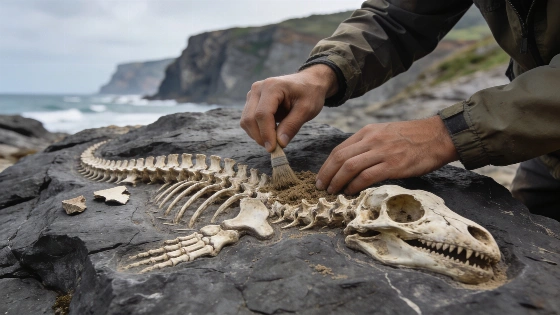
A fossil uncovered on the Asturian coast has confirmed that Ichthyosaurus anningae lived far beyond its previously known range in the United Kingdom. Found on the cliffs of Vega beach in Ribadesella, the specimen stands out for its rarity and size: at about two metres, it is the largest example of this species recorded so far.
The discovery is the result of nearly twenty years of work. José Antonio Sánchez Feliz, a Madrid resident, first spotted the fossil in 2009, embedded in the dark grey marl of the Formación Rodiles, a geological layer from the Early Jurassic. Extracting and preparing the fossil was difficult. The bones, especially those of the skull, were fragile and needed careful lab work to recover and preserve them.
The Asturian specimen provided exceptionally well-preserved cranial elements, allowing for a more precise species diagnosis than was possible with previously known British material.
Researchers identified the fossil as Ichthyosaurus anningae by analyzing the humerus and distinctive features of the skull. Until now, this species was only known from southern England. Comparing the Asturian fossil with British specimens confirmed both the species and that the individual from Asturias was a fully grown adult, larger than any previously found. Reports from RTVE and other scientific sources note that this is the first independent confirmation of the species outside the UK. The findings were published in Acta Palaeontologica Polonica.
The fossil's teeth are robust and moderately conical with rounded tips, suggesting a generalist diet. This is different from the slender, finely striated teeth of Leptonectes, another ichthyosaur found in Asturias that likely ate mostly fish. The difference points to a more varied marine ecosystem in the region's Jurassic seas than previously thought. The dental features show that Ichthyosaurus anningae filled a different ecological role, supporting the idea that Early Jurassic marine reptiles in northern Spain divided up the available food sources.
Researchers reconstructed parts of the skull, the eye socket, vertebrae, ribs, and sections of the left fin. The sediment where the animal was buried suggests it lived in a low-oxygen, muddy seabed less than 100 metres deep, alongside other marine reptiles like plesiosaurs. Ammonite fossils found in the same layer helped date the specimen to the Pliensbachian stage, about 192 million years ago.
The identification of the species was based on the shape of the humerus and diagnostic cranial features, with a detailed comparative analysis against specimens from southern England. This approach was crucial due to the better preservation of the Asturian fossil compared to the often fragmentary British material.
This find is important because ichthyosaur fossils from this Jurassic period are rare worldwide. The Asturian specimen adds a key piece to the picture of ancient marine life in northern Spain. The work involved collaboration between the Museo del Jurásico de Asturias (MUJA), Argentina’s Museo de La Plata, CONICET, and the Rochester Institute of Vertebrate Paleontology in the United States. The results were published in Acta Palaeontologica Polonica and confirmed by several international research teams.
MUJA’s collection is already known as Europe’s leading museum for dinosaur footprints, with over 700 specimens and the third largest collection in the world. The museum also holds unique pterosaur tracks, some with preserved skin impressions, and the only known Jurassic lizard footprint. The collection now includes more than 5,500 items. Experts believe the so-called ‘dinosaur coast’ from Gijón to Ribadesella will continue to produce new finds.
The newly identified Ichthyosaurus anningae will remain in the museum’s lithotheque for now, but a detailed reconstruction lets visitors see its size and shape. This discovery strengthens Asturias’s reputation as a key site for Jurassic research and expands what scientists know about prehistoric marine life in the region. The Asturian coast continues to provide evidence that challenges and refines the understanding of the Jurassic period in Europe.