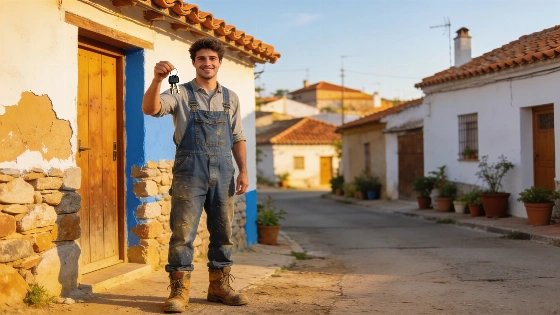
A 22-year-old construction worker from Albacete managed to purchase a house in the village of Fuensanta after years of saving. His story highlights how Spain’s rural areas are offering young people a path to homeownership that remains out of reach in the cities.
Santiago Marín, known as Santi, was just 22 when he became the owner of a house in Fuensanta, a village of 285 residents in Albacete province. After working since the age of 16 and saving diligently, Santi was able to buy his own home for €40,000—a price unimaginable in Spain’s major cities.
For many young Spaniards, the dream of owning a home has become increasingly distant. According to the Synthetic Youth Indicator (ISJ) from the PwC Foundation, it now takes an average person under 35 more than nine years of full income to afford a property. In this context, rural Spain is emerging as a rare opportunity for those willing to look beyond the city limits.
From Savings to Ownership
Santi’s path to homeownership began early. He started working at 16, taking jobs as a bricklayer, welder, and tractor driver. By the time he found the house in Fuensanta, he had built up enough savings to cover half the purchase price. “I’ve worked since I was 16 and managed to save quite a bit,” he told El Español. That financial discipline allowed him to take the leap when the right property appeared.
Instead of taking out a traditional mortgage, Santi paid half the price upfront and covered the rest with a personal loan. The modest cost of the house made this possible—an option rarely available in urban markets, where prices and lending requirements are far steeper. “It was cheap, and with my savings I paid half. Then, instead of a mortgage, I took a personal loan for the rest,” he explained.
Rural Life as a Solution
Santi’s decision reflects a growing debate in Spain about the barriers young people face in leaving home and building independent lives. “It seems like people think we can’t buy houses, but it is possible. Many of us just have the idea that we have to live in a big city,” he said. For him, the high cost of renting in cities only reinforced his choice to look elsewhere. “With rents the way they are, the best thing is to move to rural areas and buy your own place.”
His story is not unique. Across Spain, small towns and villages are seeing renewed interest from young buyers priced out of urban markets. The trade-off is clear: lower purchase prices, but often more work to make a property livable.
The Real Cost: Renovation
Buying the house was only the first step. Santi has invested around €15,000 in renovations, much of which he does himself while continuing to work full-time. His father, also in construction, occasionally helps out. For the past six months, Santi has documented the transformation on TikTok, sharing the progress and challenges of restoring an old rural home.
His experience highlights a common reality in Spain’s countryside: while homes may be affordable, many require significant investment to bring them up to standard. For buyers with practical skills and patience, the rural option can still make financial sense.
Changing Priorities
Santi’s story points to a subtle shift in how young Spaniards are thinking about independence and property. While city life remains attractive for many, the combination of high prices and limited opportunities is pushing some to reconsider what they want—and where they can realistically achieve it.
According to recent data, Spain’s rural population has been declining for decades, but renewed interest from younger generations could help stabilize some communities. For now, cases like Santi’s remain the exception, but they offer a glimpse of how the housing crisis is reshaping expectations and choices for Spain’s youth.