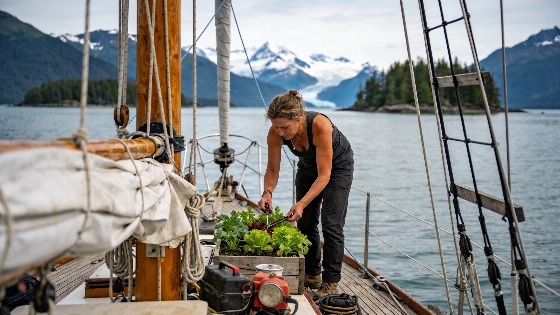
When Nikki left her job in the early 1980s, she was not trying to escape the world. She wanted to build a life she could manage on her own. Now 77, she has spent 44 years living and sailing alone on boats in Alaska, a routine that demands technical skill and mental strength.
Her journey began near Anchorage, where she first learned to sail on Big Lake. After buying a small boat and moving to Valdez, Nikki realized that depending on friends or crew left her plans at the mercy of their schedules. Determined to overcome that limitation, she taught herself seamanship, from navigation and diesel heating to repairs on the boat’s plumbing and electrical systems. She recalls that some instructors doubted she could command a boat alone, but she did not let their skepticism define her path.
Mastering Every Task
Over the years, Nikki has become a one-woman crew, responsible for the systems on board. She maintains the engine, adapts equipment to her needs and handles sewing repairs with a Sailrite machine. Her boat is both home and workshop, with a garden; it once also served as the base for a small sewing business. She grows vegetables in a compact onboard plot and has customized the vessel for Alaska with hydraulic propulsion and hydronic heating, while expanding its battery banks.
Nikki is clear-eyed about the challenges of independence. She says she would accept help if it were available, but her lifestyle means she must be ready to handle problems herself. Each adaptation and repair addresses the demands of isolation, where outside assistance may be far away.
Weeks Without Another Soul
During the summer, Nikki anchors in remote corners of Prince William Sound, sometimes spending three or four weeks without seeing another boat. Valdez remains her home port for resupplying and repairs, while much of her time is spent among islands and glaciers, with forests along the shore. The National Oceanic and Atmospheric Administration puts Prince William Sound’s area at about 6,475 square kilometers. Federal regulation also defines a Prince William Sound area for subsistence purposes, covering Alaska waters and drainages between Cape Fairfield and Cape Suckling; that designation concerns subsistence rules, not private anchoring or vessel residency.
Alaska’s marine conditions can change quickly. A National Weather Service forecast for Kachemak Bay, elsewhere in south-basic Alaska, described west winds of 10 to 20 knots and seas of 6 feet subsiding to 2 feet. That is a regional example, not a report of conditions at Nikki’s anchorages. Her isolation is deliberate: she plans voyages carefully and keeps track of her position and needs. Her story, reported by The Alaskan Gypsy Life, shows the self-sufficiency required to thrive in such an environment.
Learning by Doing
Nikki did not come to this life with a background in engineering or mechanics. She built her expertise through years of trial and error, learning through persistence. She diagnoses breakdowns and fixes them, upgrading systems as needed before deciding whether it is safe to sail. Her experience echoes that of others who have learned new trades later in life, though her circumstances are unusually demanding.
Unlike retirees who opt for the comfort of cruise ships, Nikki handles decisions and repairs aboard her vessel. She has lived on various boats in Alaska for more than 44 years, not always on the same one. Solitude is only part of the story; she also needs the operational knowledge to sustain this way of life. The physical and technical demands remain large.
The full interview with Nikki is available on The Alaskan Gypsy Life channel, offering a look at a life shaped by independence and flexibility, sustained by one woman’s quiet persistence at sea.