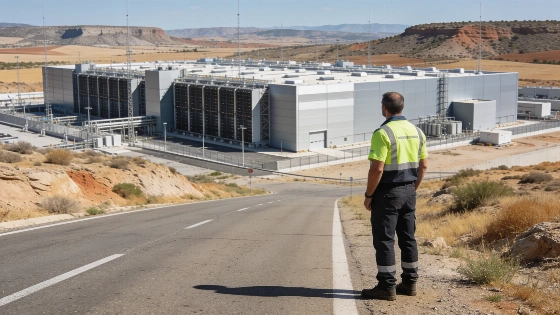
AWS will shift its municipal IAE payments in Aragón from Madrid to the towns hosting its data centres. The company will also cover the 2023-2026 tax period after pressure from local authorities and businesses.
The tax will now follow Amazon Web Services’ facilities in Aragón rather than being settled centrally in Madrid. The change affects the municipalities where AWS operates data centres.
AWS will make retroactive IAE payments covering each tax year from 2023 through 2026. The company has not disclosed the total amount.
Pressure built after CEOE Aragón criticised the arrangement. The Cluster de la Energía took the same position, as did the municipalities hosting AWS infrastructure. Their objection centred on the tax going to the Ministry of Finance in Madrid instead of to the Aragonese towns where the activity takes place. El Periódico de Aragón linked the dispute to the territorial impact of the infrastructure and the location of AWS’s operations.
AWS data centres have been operating in El Burgo de Ebro, Villanueva de Gállego and Huesca since 2022.
The revised system takes effect immediately. IAE will be paid directly to the local authorities tied to AWS data centre operations in the region. AWS has not given the exact value of the retroactive payments or a timetable for transferring them.
The measure concerns three locations. One data centre site is in El Burgo de Ebro. Another is in Villanueva de Gállego, both in Zaragoza province. AWS also operates in Huesca. The payments concern those municipalities rather than a newly created regional tax.
The change is associated with the registration of Amazon Data Services Spain under epigraph 845, covering electronic operation on behalf of third parties. According to El Periódico de Aragón, this classification allows the company to move from the national IAE system to a territorial one.
The retroactive commitment is the clearest financial element of the announcement. It covers four years of IAE payments for the municipalities where AWS runs data centres in Aragón, but the company has not provided the amounts involved.
A preliminary estimate put the potential annual total at about €522,777. Zaragoza accounted for €384,503 in that estimate. Huesca accounted for €90,817. Villanueva de Gállego was assigned €33,400, while El Burgo de Ebro was assigned €14,056. Those figures are an external estimate, not a final amount confirmed by AWS.
The dispute concerned the destination of an existing tax rather than the creation of a new levy. Under the applicable rules, a company above the relevant turnover threshold can pay IAE through the national tariff and the tax authorities instead of making separate municipal payments. AWS used that option, so the tax was settled in Madrid. It will now channel the payment at municipal level in the places directly associated with its infrastructure.
For the affected councils, the immediate issue is the recovery of four years of local tax payments. For AWS, the announcement marks a shift from centralised settlement to municipal payment after criticism from Aragón’s business organisations and local governments. CEOE Aragón and the Cluster de la Energía argued that the infrastructure, territorial burden and business activity were located in Aragón while the related tax revenue went to Madrid.
The change gives the municipalities a direct fiscal connection to the data centres on their territory. Without confirmed figures or evidence that the money has already been credited, the final financial scale of the retroactive payments cannot be assessed. AWS will now pay locally and cover the previous four years.
The decision may also matter beyond Aragón. In other Spanish regions where large data-centre operators use national tax registrations, the AWS case shows how the choice between national and municipal IAE treatment can affect revenue in territories hosting the infrastructure. That is an implication of the tax mechanism, not an official AWS forecast.