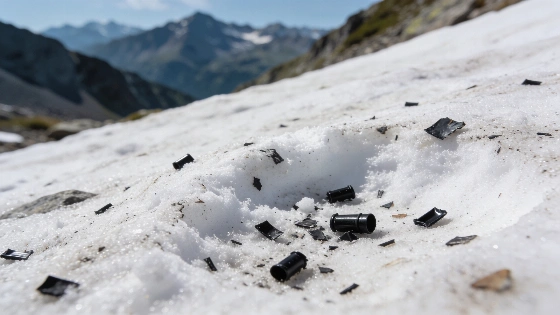
Field tests near Formigal found that microplastics can lower snow reflectivity. In older snow, they increased melting by up to 17 percent.
Around Formigal ski resort in Huesca, researchers ran six field trials on snow near the end of the season. The tests found that microplastics increased melting by up to 17% in older, denser snow. Fresh snow showed little or no melting.
The teams came from Centro de Ciências do Mar do Algarve, CCMAR in Portugal, and Instituto Pirenaico de Ecología, IPE-CSIC in Spain. Each trial used four or five surface-snow plots. Researchers also recorded changes in albedo and snowpack structure.
Единственный потенциально связанный результат веб-поиска — обзорная страница о снежном покрове Пиренеев, но она не подтверждает описанный эксперимент и не содержит данных о влиянии микропластика на скорость таяния.
Some plots received black polyethylene pellets with an average diameter of 0.3 millimetres. Other plots received black fragments measuring 0.45 millimetres. The fragments came from the wheels of a baby carriage and were used to simulate tyre wear.
Researchers exposed the snow to the particles for about four hours. Every experiment also included untreated control plots.
The starting condition of the snow mattered most.
Доступная выдача не содержит надёжной независимой первичной публикации или официального описания полевых опытов в Формигале. Поэтому DOI, дату публикации, полный состав авторов, исходные таблицы шести опытов и методику измерения альбедо, удельной площади поверхности и плотности снега необходимо проверять отдельно по материалам CCMAR, IPE-CSIC или CSIC.
Fresh snow had low density. As microplastic levels rose, the space between its grains became warmer. Its albedo fell moderately, while its specific surface area changed substantially. Little or no melting occurred in these samples. The result was similar to the controls.
Older snow responded in another way. Its density was higher, and the season was close to its end. At rising microplastic concentrations, melting rates reached as much as 17% above the rates recorded in untreated plots.
The strongest effect appeared after the snowpack had already changed physically over time. That pattern matters.
Albedo measures how much solar radiation a surface reflects. Clean snow can reflect up to 90% of incoming sunlight. Impurities lower that reflectivity and let the surface absorb more energy.
The cryosphere stores close to 70% of the planet's fresh water. Snow and ice therefore affect water availability and heat regulation.
The particles come from the global spread of plastic production. More than 400 million tonnes are produced worldwide. Between 40% and 50% of newly made plastic has a useful life of less than one year.
Around 80% ends up in landfills or the natural environment. Larger pieces then break down into microplastics below five millimetres and nanoplastics below one micrometre. These particles can travel hundreds or even thousands of kilometres through the atmosphere or ocean currents.
The study is presented as the first experimental work to show how microplastics affect snow properties. Its findings do not point to one uniform effect. Fresh, low-density snow showed limited melting. Aged, dense snow melted faster.
More field research is needed. Future tests should use different plastics, cover other locations and last longer than one day.
The evidence supports a measured conclusion. Microplastics are not only a distant pollution problem once they reach mountain snow. Under specific conditions, they can change reflectivity and speed up melting. The size of that effect still depends on snow age and density.
The Central Pyrenees trials provide direct evidence of that risk. Further experiments must show how different particles behave across the global cryosphere. Until then, reducing plastic pollution and expanding field measurements offer the clearest ways to assess its contribution to snow loss and global warming.