Police used charges to clear an exit route after striking teachers gathered outside the Chamber of Commerce. Unions put turnout at 1,000; two education officials had also faced protests.
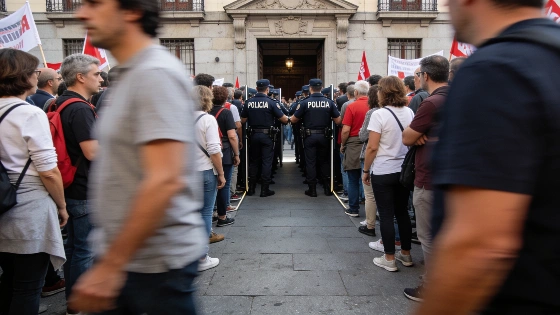
National Police officers used charges to open an exit from Madrid’s Chamber of Commerce after striking teachers blocked the area around Isabel Díaz Ayuso. The regional president had spent 72 minutes inside the building, where a forum on longevity was taking place. Unions estimated the protest at 1,000 people. The demonstration on 19 October came on the fourth day of an indefinite strike that began on 14 October and involved workers in state primary and secondary schools and the second cycle of early-childhood education. CCOO, UGT, STEM, CGT, CNT and Solidaridad Obrera called the strike, while CSIF announced a separate three-day action followed by partial stoppages.
Ayuso had criticised the Government Delegation over the lack of police reinforcements before officers cleared the way. Her education minister, Mercedes Zarzalejo, had also been targeted by demonstrators and cancelled an event. A director general for Education was heckled during a visit to a school in Vallecas. The strike sought better working conditions and more resources, with protection for state education also among the demands. Zarzalejo described them as unattainable.
The Chamber is based in the historic Casa-Palacio de Santoña, a 16th-century building that has housed the institution since 1933. During the protest, Ayuso remained inside with her team. Journalists and forum attendees were also in the building while riot police guarded the entrances. Around 20 public-order officers formed a cordon and cleared a route to Ayuso’s car. Police sources said officers used the minimum force necessary to ensure her safety and open the passage. The president demanded: «Quiero saber por qué no hay policía ni refuerzos allá donde es evidente que estas cosas están sucediendo».
Regional government sources compared the confrontation with the 2012 escrache against Cristina Cifuentes, then the Government’s delegate in Madrid. They said yesterday’s incident did not reach the same level of violence, but described it as «peor» because of its size and the pressure it placed on Ayuso’s security operation. «Nos ha recordado a aquel escrache», sources from her team said.
The confrontation came as protests continued in the capital. A housing encampment has been established in Sol, and teachers are on an indefinite strike. Healthcare workers are preparing for their own stoppage. Earlier in the day, around 200 demonstrators blocked the A-3 entrance to Madrid, disrupting traffic. Ayuso asked whether unrest seen in Paris might spread to Madrid, citing Milan and Lisbon as well. The education walkout had already brought demonstrations to central Madrid on its first day: protesters blocked part of the Castellana and gathered at Puerta del Sol, while a picket at the Complutense University campus ended in clashes. On 14 October, the regional government put strike participation at 44.6%, while unions said it was about 70%. Government representatives estimated that around 7,000 people attended the Puerta del Sol rally; organisers put the crowd at 150,000.
Three weeks earlier, the left had warned that «no habrá paz en las calles de Madrid», according to the account cited by Ayuso’s party. The Popular Party and regional councillors have interpreted that phrase as a «threat» and as a call to «quemar las calles» ahead of the 29 November elections. Those are their characterisations of the warning.
Madrid mayor José Luis Martínez-Almeida has avoided equating the city’s protests with the «gravísimas» demonstrations in France. He said there had been an increase in «episodios de violencia». A separate report on the Tarajal enclosure described competing accounts of why its gate was opened, including a Guardia Civil concern about crush risk, in the Ceuta gate report.
Zarzalejo said the pickets were becoming more radical and aggressive: «Son cada vez más radicales y con síntomas de mayor agresividad».