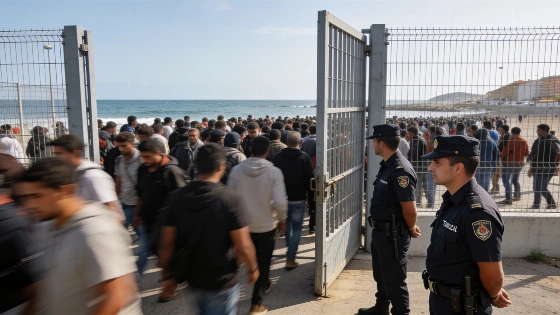
The gate stood on Spanish customs land near the Tarajal breakwater. Guardia Civil sources said it was opened to avert a crush; other sources attributed the order to the Government.
By 30 July 2026, pressure had built at a gate inside a Spanish customs enclosure about 200 metres from the Tarajal breakwater. Hundreds had gathered there. The Guardia Civil opened the gate to avert a possible crush, while sources cited by EL ESPAÑOL said the order came from the Government. The decision followed a tense disagreement between senior officers of the Guardia Civil and Policía Nacional.
Women and children were among those inside, according to the Asociación Unificada de la Guardia Civil, or AUGC. The association said the crowd was climbing the gate and walls as pressure rose, creating a real and imminent risk of people being crushed. AUGC later defended the decision as necessary and said opening the gate had saved lives.
The Policía Nacional commander favoured forcing the group back across the border, the report says. The Guardia Civil’s operations commander ultimately ordered the gate opened, and the crowd entered Ceuta. AUGC said the enclosure separated one Spanish site from another, not Spanish territory from Morocco. In its account, opening the gate therefore did not formally open the international border. The site had once been used for sanitary checks on fish consignments arriving from Morocco. It later served as a parking area and housed official facilities.
AUGC argued that those inside had crossed the frontier and were already on national territory. On that basis, it said the border-rejection procedure under additional provision ten of Ley Orgánica 4/2000 did not apply at that point. That is the association’s legal position, not a ruling on the events of 30 July. The debate also unfolded against the background of a Spanish Supreme Court decision, ruling 814/2026 of 29 June, which limited the use of border rejection for migrants who reach the breakwaters by swimming.
Agents were also dealing with limited staffing and unclear instructions from the Ministry of the Interior. Guardia Civil sources said officers had received warnings during the preceding week about the risk of a mass entry. The account described the wider influx as more than 80,000 migrants. At the Tarajal crossing, Policía Nacional handles document checks, while the Guardia Civil is responsible for perimeter security.
Gonzalo Sanz, then head of the Government Delegation’s cabinet, was present during the exchange between the commanders. On 1 October, he told judge María Tardón that he had passed warnings from the CNI to his superior at the delegation, Miguel Ángel Pérez Triano. Tardón is investigating the events in Ceuta. By 16 October, the CNI had delivered its report to the judge. She had requested material from 21 police and military units and was still waiting for documents from the Policía Nacional and the Guardia Civil.
The staffing figures cited by Policía Nacional riot-unit commanders were stark. Six officers from the Comisaría de Extranjería y Fronteras managed the border crossing, while a 12-member riot-police subgroup covered the Tarajal crossing and its surroundings. The report also says the Guardia Civil had sought a longer breakwater since 15 migrants died while attempting to reach Ceuta by sea on 6 February 2014.
RUSSPAIN has also reported on an Ibiza camp clearance involving people living in an unauthorised encampment.
Fernando Grande-Marlaska announced a project to extend the Tarajal breakwater. The first phase would add 15 metres out to sea; a later phase would extend it to 100 metres using a vertical dyke.