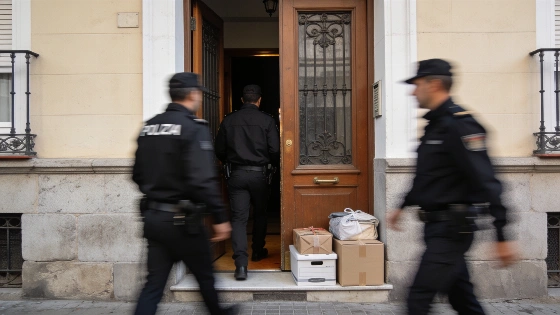
Isabel Díaz Ayuso defended Maricarmen's eviction as a court-ordered action. She blamed Pedro Sánchez for Spain's housing failures and for protests that she says are becoming more violent.
Isabel Díaz Ayuso has turned the eviction of Maricarmen into a direct fight with Pedro Sánchez over housing policy and public order. The Madrid president said the operation followed a court order and was carried out by the Policía Nacional. She also accused the prime minister of creating an atmosphere that could lead to the "quema de calles".
The case involves an 87-year-old woman from Madrid's Retiro district. She had lived since 1956 in a property on Calle Alcalde Sainz de Baranda. Ayuso said the Comunidad de Madrid did not decide to remove her. She described the eviction as the application of national legislation that the Government and its parliamentary partners had eight years to change.
The eviction was described as at least the fourth attempt to remove Maricarmen from the property. Protesters gathered outside the building, and police used force to clear a passage for the court-appointed commission.
Her argument was political as much as legal.
Speaking at a forum organised by the Círculo de Empresarios, Ayuso said the eviction was one of the 25,500 proceedings carried out each year in Spain. She put responsibility for the police intervention on the national government. She also stressed that the immediate action followed a judicial order.
Ayuso used the dispute to attack Sánchez's record on housing. She said the Government had promised 184,000 homes but had built none. She also criticised what she called an absurd housing law. In her view, the law has failed to hold down prices and has slowed home construction below the level needed to meet demand.
According to data from Spain’s judicial authorities, 4,005 evictions were carried out in January–March 2026. Cataluña recorded 921, followed by Comunidad Valenciana with 741, Andalucía with 616 and Madrid with 582.
She said the pressure is now felt in both the sales and rental markets. Ayuso linked rising housing costs and the lack of homes to economic damage and problems attracting talent. She said young people were being hit particularly hard. Her argument places the Maricarmen case inside a wider fight over who should take responsibility when court-ordered evictions meet a shortage of affordable housing.
Ayuso also rejected the idea that Madrid carries the country's biggest share of evictions. She said the highest numbers are recorded in Cataluña, Andalucía and Comunidad Valenciana, with Madrid well behind. She claimed that Cataluña sees five evictions for every one in Madrid. She tied that comparison to the region's government under Salvador Illa and to Sánchez's political arrangements.
The dispute grew after nearly 10,000 people gathered on Wednesday outside the ático acquired by the Comunidad de Madrid in Chamberí. Ayuso said Sánchez had gone to a United Nations meeting while encouraging people to take to the streets instead of dealing with Spain's serious problems. She said protests since the start of September had become more violent. Residents, workers, students and businesses in Madrid, she warned, would have to live with the consequences.
Her language went beyond criticism of one policy. Ayuso accused the prime minister of encouraging "algaradas" against her in an effort to dehumanise and harass her. She said the resulting climate was hurting companies by reducing security and making investment less attractive. The political fight has also reached Congress in a separate incident involving Ana Vázquez, described in an earlier parliamentary dispute.
The Spanish Housing Ministry called the situation extremely serious. It urged Madrid mayor José Luis Martínez-Almeida and Ayuso to intervene and stop the eviction. Sánchez called the case a "social tragedy" and said the Government would urgently speed up a new housing decree. The measures under discussion include suspending the eviction of vulnerable residents until alternative accommodation is available. They would also extend some rental contracts and tighten rules for seasonal and room rentals.
The basic facts are clear. A court ordered the eviction. A long-term resident was removed from her home. The regional president cited a national housing shortage, and protesters gathered outside a Madrid property. Ayuso's response shows that the case will not stay a local housing story.
It has become a fight between two messages. The Government points to the legal framework. Madrid calls for more construction and less political confrontation. The facts so far point to a policy failure that institutional blame or street protests cannot fix. Without more homes, residents will remain caught between court orders and housing they cannot afford.