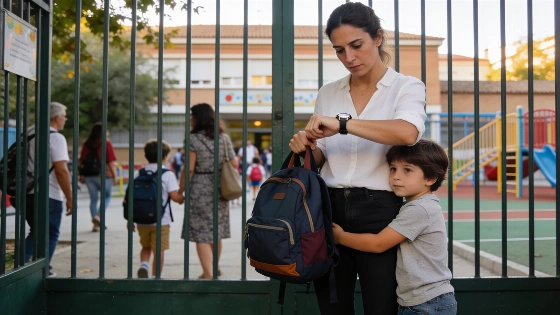
Spanish parents return to work while children start school with reduced hours. The lack of real work-life balance leaves families struggling. September highlights the mismatch between school routines and working life.
Every September, Spanish parents find themselves in a logistical mess. Schools reopen with short "adaptation" periods for children, but most workplaces expect adults back at full speed from day one. The result is a scramble for solutions that often don't exist.
Spanish labor law allows parents to request not only reduced hours but also adaptation of their work schedule, including changes in distribution of hours, remote work, or other formats, provided the request is reasonable and proportionate to company needs.
While children get time to settle in, parents are thrown straight back into work. There's no adaptation period for adults, no support, and little recognition of how hard this is for families. The system assumes someone—usually a grandparent, paid caregiver, or a flexible boss—will step in. But for single parents, dual-income households, or those without family nearby, that safety net often isn't there.
Teachers say the adaptation week is important, especially for young children starting school for the first time. But many parents can't be there for these short days. Some take unpaid leave, others rely on friends or neighbors, and many just hope their child settles quickly so they don't risk their job. The stress is real: children have meltdowns, and parents feel guilty and exhausted.
According to recent reports in the Spanish press, the average annual cost per student in 2026 is estimated at around 2,480–2,484 euros, with initial back-to-school expenses often reaching 500–550 euros per child. This financial burden is particularly acute for families with unstable incomes, and organizations representing large and single-parent families have highlighted that 59% of large families faced difficulties covering school expenses in the past year.
Many parents sign their children up for extra activities, not because the kids want them, but because it's the only way to cover the gap until the workday ends. Both children and parents come home tired, worn out by a system that doesn't really support learning or family life. A shortage of nursery places and pressure on teachers only make things harder.
Having a child in Spain often means running late, improvising, and relying on a fragile patchwork of help. For families without resources or relatives nearby, it's even tougher. The adaptation period, meant to help children, ends up exposing how little support there is for parents. The promise of work-life balance remains just that—a promise.
Spain's approach to the start of the school year points to a bigger problem: its institutions aren't built for the realities of modern family life. Until adaptation extends beyond the classroom and into the workplace, parents will keep facing impossible choices. The failure to align school and work schedules isn't just a seasonal headache—it's a structural problem that leaves families struggling every year.