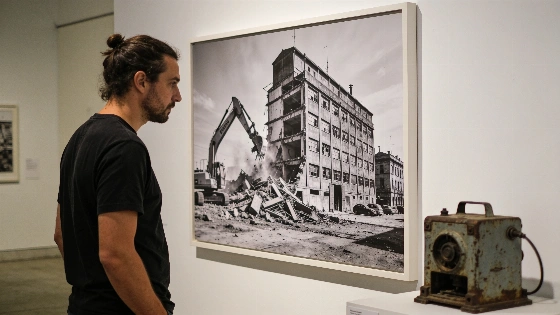
Between 1987 and 1992, Martí Llorens photographed demolitions as factories and homes disappeared from El Poblenou. Railway infrastructure was also swept into the transformation as Barcelona cleared the seafront sector near Avinguda Icària for the Vila Olímpica. The municipal company Vila Olímpica SA (VOSA) commissioned Llorens to document the redevelopment.
His record goes beyond photographs. Llorens recovered documents and objects from buildings marked for demolition, preserving physical evidence of the district’s industrial and everyday life. The broader archive contains 26,000 colour images and 18,000 black-and-white images. It also includes 15,000 35-millimetre slides. These materials now shape Arxiu Icarià. Poblenou (1987-1992) at La Virreina Centre de la Imatge.
Curated by Factoria Heliogràfica, which safeguards the Arxiu Icarià, the exhibition follows Icària’s shift from an industrial neighbourhood to the Vila Olímpica built for the 1992 Barcelona Olympic Games. It brings together more than 500 photographs, alongside documents and recovered objects. The display also includes industrial materials and plans, reconstructing the former Icària sector through traces of buildings and everyday life left by the redevelopment. Admission is free, and the exhibition runs until 28 March 2027.
The name Icària reaches further back. It came from the ideal society imagined in 1840 by French utopian socialist Étienne Cabet, built around equality and communal life. The name returned with Nova Icària, the urban-planning name for the Olympic Village, as redevelopment reshaped the area.
Llorens has also recalled the project’s social impact: more than 2,000 homes were built, he said, but the neighbourhood received no social housing. He added that the operation would not be carried out in the same way today. The exhibition’s recovered traces sit alongside other accounts of heritage protection, including a review of gargoyle conservation at Santiago’s Hostal dos Reis Católicos. Llorens’s archive documents the industrial Icària that vanished and the new district that replaced it along Sant Martí’s coastline.