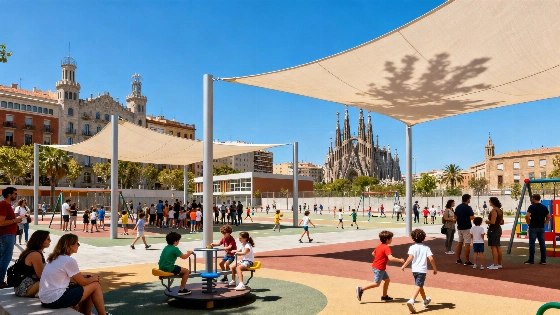
Barcelona will install 75 new shade structures this summer in playgrounds, urban spaces, and school yards. The city aims to protect residents from rising temperatures and expand usable public space.
Barcelona is set to expand its network of shaded public spaces this summer, with the city council announcing the installation of 75 new shade structures across playgrounds, urban areas, and school yards. The initiative, presented by Mayor Jaume Collboni, is part of a broader strategy to adapt the city to rising temperatures and ensure that public spaces remain accessible throughout the year.
The new installations will be distributed across 38 children's play areas, 21 urban spaces, and 16 school patios. According to the city council, these additions will bring the total number of shaded areas in Barcelona to 200 by 2027. The program is backed by a budget of €11 million and is expected to create over 40,000 square meters of shaded surface across the city.
Collboni emphasized that the primary goal remains planting more trees, but where this is not feasible, the city will use fabric canopies and other structures to reduce direct sun exposure. He noted that increasing shaded areas is essential for protecting vulnerable groups and making public spaces usable at any time of day, especially during the hottest months.
Of the 75 new shade installations planned for this summer, 38 will be located in playgrounds, covering more than 8,500 square meters. Notable sites include plaza d’André Malraux, plaza de la Sagrada Família, plaza d’en Joanic, and plaza de la Verneda. In addition, the Consorci d’Educació de Barcelona will oversee the creation of 16 new shaded areas in school yards, adding over 1,300 square meters of protection in schools such as Baixeras, Teixidores de Gràcia, Arc Iris, Pit-roig, del Mar, Anglesola, Splai, Eulàlia Bota, La Maquinista, Llacuna del Poblenou, Els Porxos, La Pau, Miralletes, Jaume I, Projecte, and Els Xiprers.
The plan also includes 21 new shade structures in urban spaces not designated as playgrounds, providing more than 5,000 square meters of coverage. Locations include plaza del Poeta Boscà, Pou de la Figuera, plaza d’André Malraux, the gardens of Doctor Duran i Reynalds, and the skatepark de la Marina.
Looking ahead, the city has announced three major shade projects for key public spaces, with a combined budget of €2.3 million and scheduled for completion between 2027 and 2028. The first will be on paseo Marítim, where two large canopies supported by columns will cover 1,600 square meters along the beaches of Nova Icària and Bogatell, expected to be ready by June 2027. The second project, in plaza Comercial near El Born, will feature a network of rhomboid fabrics supported by metal columns and concrete bases, covering 1,400 square meters and planned for May 2028. The third, and most technically complex, will be on avenida del Portal de l’Àngel, using hexagonal modules inspired by Gaudí’s tiles to shade 2,000 square meters, also scheduled for May 2028.
Collboni highlighted that the difference in perceived temperature between sun and shade can exceed 12 degrees Celsius, underlining the importance of these measures for comfort and public health. He also referenced the city’s ongoing efforts to ensure all schools are climate-controlled by 2030, criticizing suggestions that children should simply wear lighter clothing as insufficient for addressing heat in educational settings.
Barcelona’s approach reflects a growing trend among European cities to adapt urban environments to climate change. The city’s focus on both natural and artificial shade solutions aims to balance immediate needs with long-term sustainability. According to Eurostat, southern European cities have seen a steady rise in average summer temperatures over the past decade, increasing the urgency for such measures. Barcelona’s investment in shade infrastructure is part of a wider movement to make cities more resilient and livable as climate patterns shift.