A Basque museum specialist has reignited centuries-old connections between Euskadi and Canada’s indigenous peoples. Her work now shapes a major cross-Atlantic project, highlighting a legacy of mutual respect and cultural exchange.
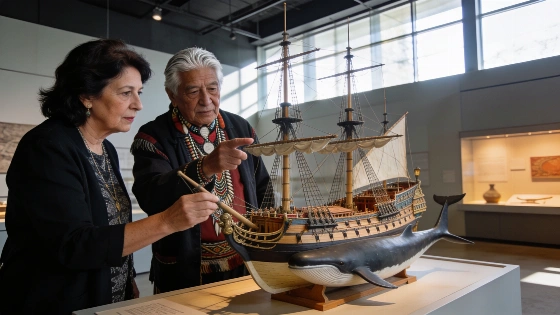
When the replica of the San Juan whaling ship sails between the Basque Country and Canada, it will do more than follow an old route. The project highlights a relationship built on cooperation rather than conquest. At the center is Idoia Arana Beobide, a Basque museologist whose work has connected two continents and two cultures, bringing attention to a shared past that predates most European colonial ventures in North America.
Arana first arrived in Ottawa with a suitcase and plans to learn English. Instead, she found herself drawn into museology—a field barely known in Spain at the time. Within three years, she was working at the Canadian Museum of Civilization (now the Canadian Museum of History), designed by Douglas Cardinal, an indigenous architect from the Blackfoot Confederacy. This experience shaped Arana’s career-long focus: documenting and strengthening the historic ties between Basque mariners and Canada’s indigenous peoples.
There is an indirect mention that the replica of the Basque whaling ship San Juan is planned to be linked with Red Bay, Labrador, with a possible arrival date around 2027.
The connection goes back centuries. In the 1500s, thousands of Basque sailors crossed the Atlantic to hunt whales and fish for cod off Newfoundland and Labrador. Unlike later colonial powers, the Basques built a thriving industry alongside local communities, trading and working together. The sinking of the original San Juan in 1565 at Red Bay ended that chapter, but the story continued in other ways.
Family ties also shaped Arana’s time in Canada. Her uncle, Josetxo Beobide, was a chaplain in St. John’s, Newfoundland, helping Spanish fishermen with translation and emergencies. This practical support echoed the approach Arana would later take in her own work: building bridges, not barriers.
At the museum, Arana met Douglas Cardinal. His architectural vision was rooted in indigenous values—dialogue, respect for nature, and community. Their partnership, both professional and personal, became a real-life example of the principles they wanted to highlight. Cardinal, who had faced political resistance to indigenous rights even with support from Prime Minister Pierre Trudeau, found in Arana someone who understood the importance of listening and shared responsibility.
According to available information, the Red Bay National Historic Site in Labrador is historically connected to Basque whaling activities, and current discussions about the San Juan replica project continue to reference Red Bay as a key destination. However, official details about the voyage, participants, or institutional statements from Parks Canada or Basque authorities have not been confirmed in recent public sources.
For both Arana and Cardinal, the Basque-indigenous relationship was never about domination. Cardinal notes that the Basques shared their fishing knowledge, while indigenous communities offered resources in return. The Basque word for relationship, "harremana," means "to give and to receive"—a concept that shaped both their historical interactions and Arana and Cardinal’s own lives together.
Their story had its complications. Cardinal, already separated from his third wife, and Arana, then in her early twenties, faced skepticism from family and the challenge of blending traditions. Their marriage—first in Las Vegas, then in a Basque sanctuary—symbolized the merging of worlds. Today, their two children carry a lineage that spans the Atlantic, much like the mariners who once crossed those waters.
The renewed focus on the Basque-Canadian connection comes as the Gipuzkoa provincial government and Canadian partners prepare for the San Juan replica’s voyage. The project is more than a historical reenactment; it is a statement about the value of cultural memory and the possibility of respectful exchange across borders. At a time when many historic sites face neglect or closure—like the family-run newsstand in Madrid’s La Latina, as reported earlier—the San Juan initiative stands out for its commitment to reviving shared heritage rather than letting it disappear.
To understand the significance of Arana’s work, some context helps. The Basque presence in North America is one of the earliest examples of European-indigenous cooperation, predating British and French colonization. The Basques even developed a pidgin language to communicate with local peoples, showing practical collaboration. Today, the San Juan project is not just about rebuilding a ship; it is about rebuilding a narrative that challenges the usual story of European expansion as inevitable conflict. By focusing on a history of exchange and mutual respect, Arana and her collaborators offer a model for how cultural memory can help build bridges now. This approach, grounded in action and historical evidence, stands out in a time when public discussions of the past are often simplified or erased. When history is treated as an ongoing conversation, it can still shape the present in real ways.