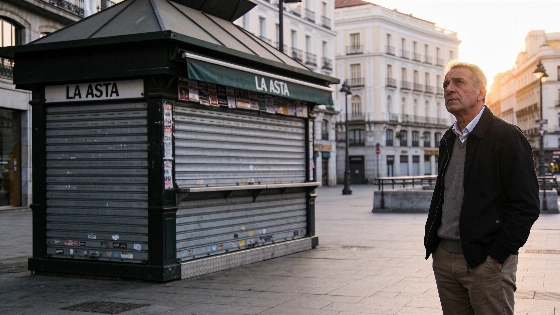
Antonio Izquierdo retires after three decades running his kiosk in La Latina, Madrid. With no one to take over, the closure ends a family tradition and highlights the decline of local newsstands.
One of Madrid’s oldest family-run newsstands has closed its shutters for the last time. Antonio Izquierdo, who has managed the kiosk in Puerta Cerrada, La Latina, for over 30 years, retired this week at age 65. With no successor from his family or the neighborhood, the business—operated by three generations since before the Civil War—now faces an uncertain future.
Antonio’s final day began as usual, before dawn, arranging newspapers and preparing for regular customers. But this Monday, each transaction came with a farewell. Many clients, some of whom have bought their daily paper here for decades, expressed regret and gratitude. Antonio, who knows each customer’s preferences by heart, admitted mixed feelings: sadness at leaving, but relief at ending the early mornings that defined his routine.
The kiosk’s story began with Antonio’s grandmother, Asunción, who sold newspapers on wooden boards across the street. His mother, Antonia, continued the trade, first from a wooden stall, then a metal one built by Antonio’s father. Antonio himself grew up helping with deliveries and eventually took over in the early 1990s after losing his previous job. For years, he worked long hours, only recently reducing his schedule by hiring help and working two days a week.
For many locals, the kiosk was more than a place to buy the news. Customers like Paloma, a regular for over 30 years, described Antonio as a unifying figure in a neighborhood increasingly shaped by tourism. She lamented the loss of traditional shops and the sense of community, recalling moments when Antonio’s trust and support went beyond business. The closure, she said, marks the end of a daily ritual and a piece of local identity.
Antonio has witnessed La Latina’s transformation firsthand. Traditional businesses have given way to bars, restaurants, and tourist apartments. The older clientele has dwindled, and younger generations rarely buy print newspapers. Despite diversifying with souvenirs and parcel services, Antonio estimates that newspapers and magazines still account for 80% of sales. He notes that his central location helped him survive longer than many colleagues, but the overall trend is clear: only one other similar kiosk remains in the area, while others have closed or shifted focus.
Over the decades, Antonio’s kiosk has seen the city’s history unfold—from Franco’s death, when newspapers sold out instantly, to the social changes of the Transition. He remembers the excitement of new publications and the role kiosks played as community hubs. Now, as he steps away, he hopes someone will continue the tradition, but so far, no one has committed. He wants the kiosk to remain focused on news, not just souvenirs for tourists.
The broader context is challenging. The Madrid Association of Professional Press Vendors (AVPPM) reports around 300 kiosks still operating in the capital, but warns of uncertainty as many licenses expire in 2029 and negotiations with city authorities stall. While most recent retirees have managed to transfer their businesses, Antonio’s case highlights the difficulty of finding successors willing to take on the demanding schedule and modest earnings.
Antonio’s children have chosen other careers, and he understands their reluctance. Still, he says that if he were 30 years younger and guaranteed a long-term license, he would continue—perhaps with a wider range of products. For now, he closes the kiosk with gratitude for his customers and the memories built over decades. The disappearance of such local businesses is part of a wider trend in Spanish cities, where traditional commerce faces pressure from changing habits, digital media, and tourism-driven economies.
Similar challenges have been seen in other historic sites adapting to new realities, such as the transformation of the Cortijo del Fraile in Almería into a cultural center after years of neglect, as reported in the recent coverage of landmark restorations.
The closure of Antonio’s kiosk is more than the end of a business. It reflects the fading presence of neighborhood institutions that once anchored daily life in Madrid. As the city evolves, the loss of such places raises questions about the future of local identity and the spaces where communities connect.