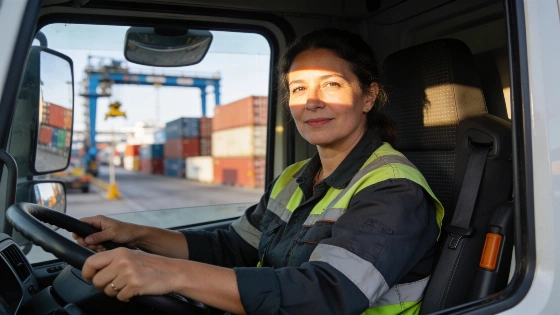
Begoña has spent over three decades driving trucks across Spain, navigating demanding schedules and family life. Her story sheds light on the realities of a profession still dominated by men and the challenges women face in the transport sector.
When Begoña first stepped into the cab of a truck in Valencia, she was not just learning a new job—she was entering a world where women were almost invisible. With 31 years of experience in the transport sector, she has become a rare voice for female truck drivers in Spain, openly sharing the realities of her profession and the personal choices that have shaped her life.
Begoña’s journey began alongside her husband, spending six years as his co-driver. Those early days, as she recalls, were the “last echoes of the old trucker lifestyle.” She started from scratch, learning to maneuver heavy vehicles and facing the curiosity—and sometimes skepticism—of colleagues unaccustomed to seeing a woman behind the wheel. “I would arrive at a warehouse and everyone would come out to see me, because I was the first woman they’d ever seen driving a truck,” she remembers.
Her husband became her mentor, encouraging her to ignore doubters and focus on her own progress. “They know less than you,” he would say, helping her build the confidence to master the job. But the challenges extended far beyond the road. Balancing the demands of long hours and family life proved especially tough. Begoña recalls a moment when her four-year-old daughter insisted she wanted to be “a truck driver like mom,” only to have her teacher correct her, assuming she meant her father. The child’s determined response—“No, like my mom”—captures the quiet impact of Begoña’s example.
Today, Begoña uses her social media presence to give visibility to a profession still seen as male territory. She is candid about the realities: the pay, the hours, and the regulations that govern her work. While her monthly earnings can reach €3,000, she is quick to point out that the compensation does not reflect the time and dedication required. Spanish law limits truck drivers to nine hours of driving per day, with two days a week allowed to stretch to ten. Continuous driving cannot exceed four and a half hours without a 45-minute break, which can be split into shorter rests. Daily rest periods are set at 11 hours, though three times a week this can be reduced to nine. Weekly driving is capped at 56 hours, and over two weeks, the total cannot exceed 90. After a full week on the road, a 45-hour rest is mandatory, though it can be shortened to 24 hours in some cases.
Despite the demanding schedule and the sacrifices involved, Begoña remains proud of her path. She sums up her career as “the result of living her life by making her own decisions,” adapting her work to fit her family, not the other way around.
According to elespanol motor, Begoña’s story highlights both the progress and the persistent barriers for women in Spanish transport. While the number of female truck drivers remains low, her visibility and openness are helping to challenge stereotypes and encourage more women to consider the profession. In Spain, the transport sector is still overwhelmingly male, but stories like Begoña’s suggest that change, though slow, is possible.