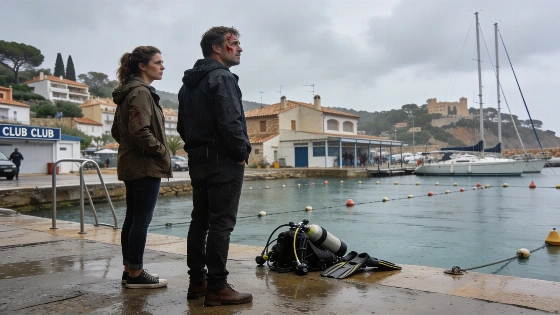
The death of Marc Ortega in Sa riera remains unresolved after two years. His family criticizes the lack of judicial action and demands accountability. Official reports point to serious safety violations.
Two years after the fatal workplace accident that claimed the life of 23-year-old Marc Ortega in Sa riera, Begur, the case remains stalled with no judicial progress. Ortega drowned in May 2024 while installing mooring lines underwater for the Club Náutico de Sa riera, a task he was reportedly pressured to perform without proper equipment or training. Despite the gravity of the incident, the investigating court in La Bisbal d’Empordà has yet to take a single statement from those involved, leaving the victim’s family in a state of frustration and disbelief.
Marc’s parents, Marta Cabañó and Paco Ortega, have returned to the site of the tragedy, voicing their anger at the lack of accountability. They argue that those responsible for workplace safety have faced no consequences, while the club continues to operate as usual. According to their account, Marc was asked to complete the mooring installation after a subcontracted company left the job unfinished. Lacking the necessary gear, he improvised with borrowed equipment and a makeshift weight belt, performing repeated breath-hold dives to secure the lines. The accident occurred when a carabiner attached to his waist became entangled with a chain, trapping him underwater. Despite desperate rescue attempts by colleagues and bystanders, Marc could not be revived.
Official reports from the Labour Inspectorate and the Guardia Civil’s underwater unit highlight severe breaches of safety regulations. The findings indicate that Marc was assigned a hazardous task without the required support, training, or rescue measures. The Labour Inspectorate proposed a fine of €24,585 for the employer, citing a pattern of negligence and disregard for legal procedures. The technical report from the Guardia Civil concludes that the absence of a legally mandated support team directly contributed to the fatal outcome, describing the incident as a likely case of professional negligence with possible criminal implications.
Despite these findings, the judicial investigation has not advanced. The club’s board members have exercised their right not to testify, and the family’s lawyer continues to push for progress, emphasizing the need to clarify whether Marc’s death could have been prevented and who should be held responsible. The local council maintains that it provided all requested information, but investigators suspect lapses in oversight and control. The union CC OO has not ruled out legal action against those deemed responsible for the safety failures.
The case echoes other Spanish tragedies where victims’ families have struggled for answers and accountability. For example, the aftermath of the Biescas camping flood, which killed 87 people, saw survivors and locals grappling with trauma and legal inertia, as detailed in this report on the Biescas disaster anniversary. Both cases highlight ongoing challenges in Spain’s approach to workplace and public safety, as well as the difficulties families face in seeking justice.
Marc Ortega was well known in Sa riera, described by friends as hardworking and generous. He had worked at the club since 2021, rising to team leader. The lack of progress in the investigation has left his family and colleagues without closure. The case remains a stark reminder of the consequences of inadequate safety measures and the slow pace of judicial response in Spain. According to official data, workplace accidents involving underwater tasks are rare but often fatal, underscoring the importance of strict compliance with safety protocols. The outcome of this case may influence future enforcement and awareness of occupational risks in similar settings.