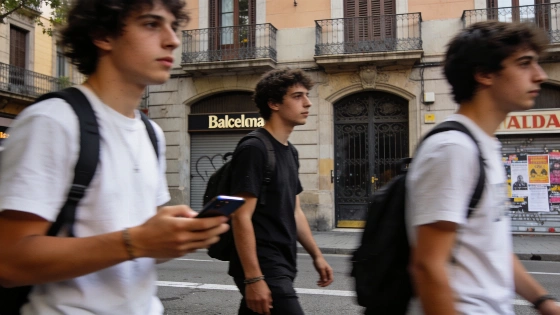
On 24 October 2026, a Barcelona mobilisation promoted under the name Blocus escalated into looting and fires, followed by clashes with the Mossos d’Esquadra around Plaça de Catalunya. The calls had presented themselves as an extension of French secondary-school protests, including the movement known as Lycées Indignés, and called for more resources and better facilities, alongside enough teachers and quality education. The disturbances shifted from education-related slogans to disorder without a clearly defined political demand. Official sources say most participants were minors.
The campaign is built for rapid circulation online. Anonymous profiles post similar-looking posters, then disappear as new accounts take their place. The designs appear to have been made with artificial intelligence. White and red lettering sits over an image of the city named for the protest; flames also feature in the artwork.
Organisers use TikTok to spread the calls and direct users towards private WhatsApp* (принадлежит Metа, которая признана экстремистской организацией и запрещена в РФ) and Telegram groups. QR codes and direct invitations provide access. Inside those channels, participants are told where and when to meet, along with what to wear and bring. Mossos chief commissioner Sílvia Catà said organised TikTok groups had recruited young people. She described the Barcelona gathering as intended for criminal acts rather than an ordinary demonstration.
The Barcelona episode produced at least 128 arrests, including 72 minors, in police figures reported on 25 October. A subsequent RTVE update put the total at 130 arrests, including 74 minors. Reports also counted 23 vandalised shops and 14 injured Mossos officers, four of them seriously. El País reported approximately 500 people directly involved in the disturbances, as well as 33 fires in central Barcelona.
The Spanish reach has drawn attention beyond Barcelona. Blocus-related calls also targeted Madrid and Zaragoza, along with other cities. A previous report on possible Blocus action in Zaragoza described the role of an anonymous platform in mobilising young people, as detailed in the Zaragoza report.
Platform design can help such material travel quickly. Algorithms tend to favour posts that attract interaction and strong emotional reactions, shaping what users see and narrowing the range of perspectives. Social movements have also learned to adapt their messages to platform rules. Short videos can pair striking imagery with overlaid text. Posting around a trending topic can push a call across thousands of screens within minutes.
That amplification does not mean social media alone causes violence. Research cited in the source material describes how platforms can speed up mobilisation and strengthen a sense of group identity during periods of social and political tension. A separate study of Gab found that users posting hate speech were more connected to one another, helping those messages circulate to a wider audience.
Online networks can also carry practical information during protests. A 2018 study of international demonstrations described how the internet enabled strategic information to flow during events and reinforced shared demands. The way users are connected affects who receives that information and how far a call can travel.
The Mossos d’Esquadra opened an investigation into the anonymous Blocus platform to identify those behind the calls and determine whether the online operation was created to facilitate criminal conduct. Police monitored TikTok accounts using the name Blocus Barcelona; the accounts and their posts were later deleted. Police also reportedly identified about 450 people during the operation. Some detained participants were under 14, below Spain’s age of criminal responsibility; most detained minors were reported to be 16 or 17.
Catalonia’s interior councillor, Núria Parlon, said the participants did not appear to be pursuing a specific demand and characterised the objective as vandalism. The investigation continued to examine social-media activity and the movement of users from public TikTok posts into private messaging groups.
Telegram has blocked groups linked to Blocus. TikTok says it removed videos promoting criminal activity and deployed a specialist team to curb their spread. The platform also says it interrupted livestreams while suspending accounts. It strengthened moderation and limited searches and recommendations related to the messages.
Those measures do not prevent content from moving elsewhere. Posts can be recirculated through screenshots or alternative links, making complete control difficult.