Josep Borrell has warned that Europe’s military supply chains are dangerously exposed. As defence industry leaders meet in Cartagena, the call for greater autonomy grows louder.
Europe’s military supply lines are thin. If the main arms exporters cut off sales, the continent would be left with empty hands. That was Josep Borrell’s message in Cartagena. The former Spanish minister and ex-European Commission vice president did not sugarcoat the problem. Europe depends on foreign powers for its weapons. The risk is real.
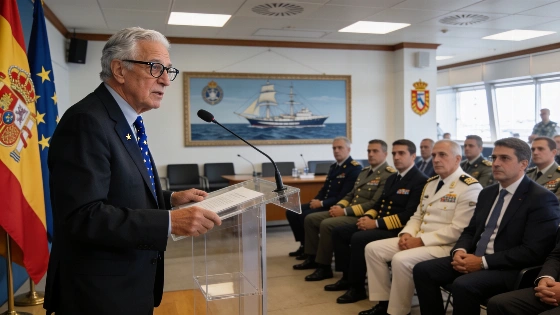
Borrell spoke at a high-level meeting of the Consejo Asesor del Clúster de la Industria de Defensa (CID) at the Club Naval de Oficiales de Cartagena. More than fifty top military officers, defence executives, and industry leaders filled the room. Their focus: the weak spots in Spain’s and Europe’s defence sector.
According to SIPRI, between 2020 and 2025, European NATO members increased their imports of major weaponry by nearly 150% compared to the previous five-year period.
Borrell did not hold back. “If tomorrow the countries that sell us armaments stop doing so, we will have none,” he said. Europe relies on outside suppliers for 60% of its defence industry needs, according to Borrell. He singled out the United States. Washington, he warned, is tired of paying for Europe’s security and sending Americans to fight in foreign wars. “The Americans are tired of paying for our weapons and sending their people to die in wars that are not theirs.” Independent research shows EU countries buy less than half their main armaments inside the Union. About a third comes from the US. Borrell’s warning about high external dependence holds up, but the exact "60%" figure for the whole defence industry is not fully confirmed, as Investigate Europe points out.
Borrell also criticized Europe’s lack of unity. He called out the gap in military strength. Germany is arming fast. Other European countries lag far behind. “Germany is now the fifth largest arms holder in the world, but the rest of Europe is at a huge distance,” he said. Borrell remembered his own failed push for a 5,000-strong EU rapid intervention force. It never happened. “There is no emergency military unit to respond to incidents in Europe, and as a result, there will never be a European army.” Germany’s military spending has soared since Russia’s full-scale war against Ukraine. But the claim that Germany is the "fifth largest arms holder" depends on how you count—by spending, stockpiles, or total power. No independent source confirms that exact ranking.
Admiral General (ret.) Fernando García Sánchez, president of the CID advisory council and former JEMAD, summed up the meeting’s conclusions. He called for urgent action. Small and medium-sized businesses must join the defence sector. The armed forces need more investment. García Sánchez said the CID should lead Spain’s defence industry and make sure companies can supply all three branches of the military. The idea of a 5,000-strong European rapid deployment force matches earlier EU discussions. But independent sources confirm it remains just a concept. There is no formal document with all the details of Borrell’s plan.
In 2025, EU countries spent €418 billion on defence, representing 2.2% of their combined GDP. However, only 24% of defence equipment spending was conducted jointly, falling short of the European Defence Agency’s 35% benchmark.
The Cartagena meeting drew a heavyweight crowd. Alfonso Bourgon, president of the Clúster de la Industria de Defensa, attended. Rear Admirals Nicolás Monereo and Antonio González were there. Tomás Martínez Pagán, president of the Federación Regional de Empresarios del Metal de Murcia (FREMM), joined the talks. So did Andrés Baraza, CEO of Integralia, and Jesús Martínez, president of INDUTEC. Their presence showed how serious the problem is. Europe cannot count on foreign partners to always deliver. SIPRI and other top research groups confirm the US is still the main outside supplier. European NATO countries signed major defence contracts worth about $366.7 billion from 2020 to 2025. Roughly $111 billion—almost a third—went straight to American companies.
The push for European defence autonomy is not new. It matches recent moves in other key sectors. As reported earlier, Spanish leaders have also backed homegrown aerospace projects to cut reliance on outside suppliers. The message from Cartagena is blunt. Without a real industrial plan and serious investment in local capabilities, Europe could be caught off guard in the next crisis. Analysts warn that if US priorities change, Europe’s dependence on American defence firms could get even worse. The risk is highest in maintenance, ammunition, spare parts, and air defence systems.
Europe’s patchwork approach to defence buying and its habit of importing weapons can’t be ignored any longer. Cartagena’s warnings are a wake-up call. Policymakers have put off tough choices about military autonomy for too long. If Europe does not build its own industrial base, it will stay vulnerable. The European Defence Agency has started to act. It set up a €7 billion European Defence Fund for joint research and new capabilities. The SAFE program offers €150 billion in preferential loans to boost production and joint buying inside Europe. The clock is ticking.