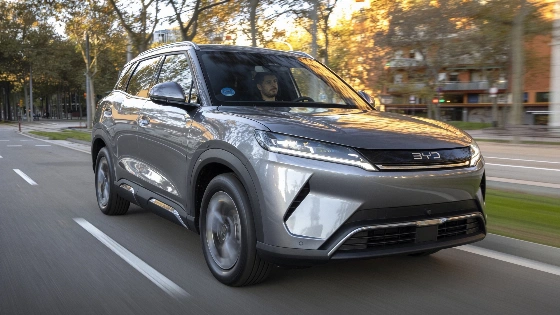
With a starting tariff price of €29,990 and an official range of up to 430 km, the BYD Atto 2 targets Spanish drivers looking for an electric SUV suited to daily life without a premium price tag. Launched in Spain in 2025 as a fully electric model, it later added plug-in hybrid options while keeping its focus on value and usability in a crowded segment. The 430-km WLTP figure applies to the 64.8-kWh version. The electric lineup also includes a 45.1-kWh battery, and Spanish-market prices reach €36,200 before incentives or promotional discounts.
The Comfort trim, currently the top of the Atto 2 lineup, comes with generous standard equipment. It gets 17-inch alloy wheels and tinted rear windows, plus multiple USB ports alongside a 12.8-inch central touchscreen. Inside, the redesigned center tunnel replaces traditional gear selectors with straightforward buttons. Spanish comparison data lists the electric versions at 177 hp and 204 hp, putting the Comfort at the top of that range.
Measuring 4,310 mm long with a 2,620 mm wheelbase, the Atto 2 is compact by SUV standards but has a spacious cabin. The front seats offer ample width, while rear passengers get useful legroom for the class. Its 450-liter boot, even with the seats up, adds everyday versatility for small families. In a Spanish-market comparison, the Atto 2’s maximum 430-km WLTP range edges past the Volkswagen ID. Cross’s cited 426 km, giving the BYD a small lead on headline range.
The Comfort pairs a 204 hp electric motor with BYD’s 64.8 kWh Blade Battery. Its official combined range is 430 km, and certified consumption is 17.4 kWh/100 km. In real-world conditions, consumption is closer to 18.6 kWh/100 km, a respectable figure for a vehicle of this size and capability. The Atto 2 feels agile in city traffic, thanks to its compact dimensions and light steering. On highways, it delivers a quiet, stable ride. On winding roads, the suspension favors comfort over sportiness; its slightly soft setup is still firmer than that of some other BYD models.
For buyers concerned about battery longevity, a Swedish used-car analysis examined 9,954 battery-health tests carried out between 2022 and 2026 on electric vehicles that had traveled roughly 100,000 km. The Kia e-Niro recorded 97.25% battery health, while the Hyundai Kona came in at 97.18%. The Kia EV6 posted 95.95%. These observational results offer context on battery retention, not a direct durability test of the Atto 2; performance can vary by vehicle version, battery chemistry and supplier. A review of battery health across nearly 10,000 electric cars details the analysis. BYD’s Blade Battery uses LFP chemistry, and its design aims to address concerns about long-term performance and safety.
Pricing is basic to the Atto 2’s appeal. The entry-level Boost starts at €29,990, while the Comfort trim tested here is listed at €36,200 before incentives. So the under-€30,000 price applies to the entry model, not the Comfort configuration. BYD has also expanded the nameplate with DM-i plug-in hybrids, which are distinct from the fully electric versions. Spanish-market reports list Active and Boost variants priced from €28,200 to €31,200. The Active pairs a 7.8-kWh battery with about 40 km of electric WLTP range; the Boost has an 18-kWh battery and about 90 km of electric range. Both use a 1.5-liter four-cylinder petrol engine.
The plug-in hybrid Boost is reported at 212 hp and 300 Nm, with a 0-100 km/h time of 7.5 seconds and a top speed of 180 km/h. BYD states a combined range of up to 1,000 km, supported by a 45-liter petrol tank. The Active is listed at 166 hp, with reported combined consumption of 3.1 l/100 km. For a plug-in hybrid, fuel consumption depends heavily on charging frequency and how much driving is done electrically. The published figure so does not offer a like-for-like measure of fuel use when the battery is depleted.
As Spain’s electric vehicle market matures, models like the BYD Atto 2 are changing expectations of what an affordable EV can offer. Its everyday usability comes with thoughtful features, while competitive pricing shapes what families and commuters can expect from the next generation of electric SUVs. The separate DM-i range gives buyers another powertrain option, with specifications distinct from those of the fully electric model.