
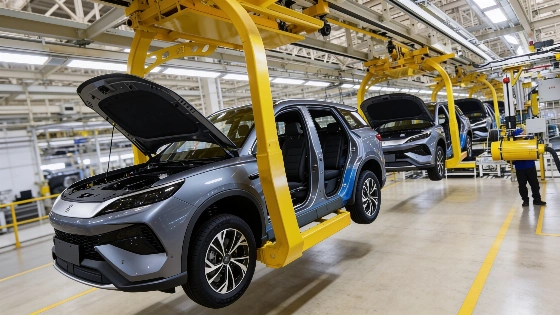
BYD is close to choosing a site for its second European car factory, with Spain and France leading the shortlist. The company’s push for local production is a direct response to EU tariffs and new rules on local content.
BYD is preparing to pick a location for its next European car assembly plant, with Spain and France as the main contenders. The company already has a factory under construction in Hungary, but this new site would mark a bigger step in its European expansion.
Instead of shipping cars from China, BYD now plans to build a full manufacturing network in Europe. The company aims for three car factories and a battery plant on the continent, driven by rising sales and the need to work around stricter EU trade rules. Reuters reports that Spain and France are the top choices for the second plant, while Italy is a backup. A final decision is expected by the end of 2026.
BYD is not planning a greenfield project, but is instead focused on acquiring and repurposing an existing underutilized factory in Europe to accelerate its expansion and reduce costs.
Alfredo Altavilla, BYD’s European advisor and former Fiat Chrysler executive, confirmed that Spain and France are the priorities, with Italy as a fallback. Rather than building from scratch, BYD is looking to buy and update an existing underused factory, which could save time and money. The company is in talks with European manufacturers and governments to find a suitable site. Automotive World notes that this approach should help BYD adjust quickly to local market needs and regulations.
The timing matters. The European Commission currently imposes extra duties on electric vehicles imported from China. For BYD, the total tariff is 27%—a 10% EU import duty plus an extra 17% for the company, according to several industry sources. The often-quoted 35.3% tariff applies to SAIC/MG, not BYD, as recent fact-checks in electrive and EU Today have clarified. BYD’s move to local production is a direct response to these tariffs and to expected 2027 rules that will require more EU-sourced parts in cars sold in the region, as reported by Reuters.
Hungary has already secured BYD’s first European passenger car plant in Szeged, announced in 2023. The Dolphin Surf is among the models planned for production there. BYD is also building its European headquarters and R&D center in Budapest, signaling a long-term commitment to the region. The Hungarian plant is a key part of BYD’s strategy to meet EU regulations and support its growth targets.
Reuters notes that BYD’s decision on the second plant location is influenced not only by tariffs but also by upcoming EU requirements for local content in electric vehicles, which are expected to become stricter by 2027. This regulatory shift is prompting Chinese automakers to accelerate their search for suitable European production sites.
BYD’s international sales highlight the urgency. In the first eight months of 2026, the company sold 1,162,260 vehicles outside China, up 85.72% from the previous year. In August alone, 189,466 units were sold abroad, making up 43.03% of total monthly sales. Deutsche Bank data shows BYD aims to reach up to 2 million overseas sales by the end of 2026 and over 2.5 million in 2027, with Europe as a major focus.
The expansion goes beyond the BYD brand. The group’s premium arm, Denza, is rolling out new models and opening retail locations in cities like Turin and Paris. Other Chinese automakers are making similar moves, as seen in recent launches aimed at the Spanish market.
For Spain, hosting BYD’s next factory would mean new industrial jobs, a stronger local supply chain, and a bigger role in the electric vehicle sector. France is still in the running, but BYD’s focus on buying an existing underused plant could give Spain an edge, given the current availability of such sites.
As BYD weighs its options, the decision will show how Europe fits into the global electric vehicle market. The company’s push for local production, despite regulatory hurdles, signals that competition in Europe is heating up. For policymakers and industry leaders, BYD’s next move will test how open and competitive Europe’s car sector can stay as the market changes.