A single photo of the BYD Great Seagull at a Flash Charging station has changed the outlook for affordable electric cars. The image points to a big jump in charging speed and tech for city drivers.
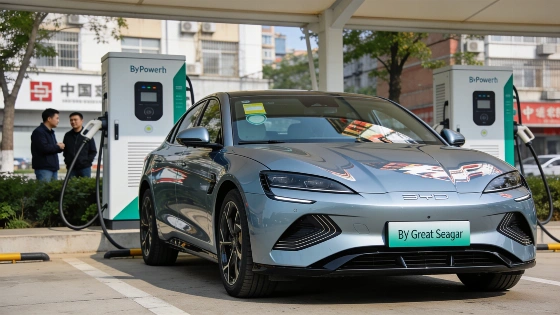
One photo has changed the story for budget electric cars in China. The BYD Great Seagull, once thought too basic for the brand’s top Blade 2 battery, has now been seen parked at a Flash Charging station—BYD’s own megacharger. No camouflage. No staged press event. Just a real car, out in the open. This is the first hard sign that BYD might bring ultra-fast charging to the city car class.
The image, posted by Liang Xiao Ping on Weibo and reported by CarNewsChina, shows the new Seagull set up for what looks like an official photo shoot. Carmakers don’t do this unless the car can actually use the charger behind it. The message is simple: BYD is getting ready to show off the Great Seagull’s ability to use Flash Charging. This could change what buyers expect from entry-level EVs. Reuters has reported that BYD already has megawatt-class Flash Charging systems and Blade batteries that can charge from 10% to 97% in just nine minutes. This tech is real, not just a rumor.
BYD officially announced it reached 2,000 highway Flash Charging stations three months ahead of schedule, marking a major milestone in its 'Flash Charging China' strategy.
But BYD is keeping the details close. There’s no official word on the system voltage or the top charging power. The MIIT homologation lists two LFP batteries—30 kWh and 39.2 kWh—both made by FinDreams. They offer CLTC ranges of 320 and 420 kilometers. The LFP label doesn’t say if these are first or second generation Blade batteries. Chinese sources, as cited by CarNewsChina, say Flash Charging will likely be for higher trims, probably the bigger battery. That fits BYD’s pattern with other models.
The numbers matter. If the Great Seagull gets the Blade 2 battery, the specs are eye-catching. BYD says it can charge from 10% to 70% in five minutes, and 10% to 97% in nine minutes—even at minus 30 degrees Celsius. For the 39.2 kWh battery, that’s about 23.5 kWh in five minutes. The average power is 282 kW, with peaks over 300 kW. For comparison, the Dolphin Surf charges at under 90 kW. The Geely E2 averages 60 kW between 10% and 80%, taking about 30 minutes for a similar charge. The Great Seagull could do it in five. That’s a sixth of the time. It could add 200 kilometers of range in five minutes.
Still, the 1,500 kW figure often linked to Flash Charging is about the charger, not the car. The real test is whether the Seagull’s system runs at 400 or 800 volts. Higher voltage means less current for the same power, but it costs more. It needs better electronics and cooling. Most CCS2 chargers in Europe max out at about 500 amps. So, the Seagull’s real charging speed will depend on both its voltage and the chargers it plugs into.
While there is growing anticipation in the market and media that the updated Seagull will feature second-generation Blade Batteries and Flash Charging, BYD has not yet officially confirmed these specifications for this model. Regulatory filings through MIIT have revealed two LFP battery options—about 30 kWh and 39.2 kWh—providing a basis for evaluating which variant could theoretically support Flash Charging.
Price is still unknown. The current Seagull sells in China for 69,900 to 85,900 yuan (about 9,200 to 11,300 euros before taxes and homologation). The new model is bigger and better equipped, so it will cost more. If BYD can offer Flash Charging below 100,000 yuan (around 13,100 euros), it would be a first for the brand at this price. Until now, the cheapest BYDs—Seagull, Dolphin, Yuan UP—haven’t had Blade 2, even though half the lineup already uses it. Earlier reports said the Seagull and Dolphin wouldn’t get Blade 2 until 2027. This new photo hints at a much earlier launch.
Market pressure is building. In August, BYD sold 10,103 Seagulls in China. The rival Geely Xingyuan (sold in Spain as the Geely E2) sold 39,651 units. Geely is ahead in size, seats, and sales. BYD’s best move is to jump ahead in charging speed, not fight on price.
The Great Seagull’s place in the lineup is still unclear. It was first announced as a model between the Seagull and Dolphin. Later, BYD’s Zhang Zhuo called it the “second generation Seagull.” The company hasn’t said if it will replace the current Seagull or sit above it. The new car is 4,205 mm long—42.5 cm longer than the old Seagull and just 6.5 cm shorter than the Dolphin. It has a single 95 kW front motor and a top speed of 150 km/h. The design brings trident-shaped headlights, a lower window line, and a simple interior with all info on a central floating screen.
For buyers in Europe, things get tricky. The 3.78-meter Seagull is sold as the Dolphin Surf, stretched to 3.99 meters with bigger bumpers. BYD just launched five-seat versions of the current body in Spain, starting at 24,490 euros for the Boost trim. The fifth seat came through rehomologation, not a new model. This shows BYD plans to keep the current Dolphin Surf in Europe for now, especially after sales dropped due to the missing fifth seat. But in China, the Seagull was refreshed in May and replaced just four months later. Europe could see the new model sooner than expected, but there are no confirmed dates yet.
BYD’s charging plans are just as bold. The company has promised 300 Flash Charging stations in Spain, open to any car with a CCS2 plug and priced under 0.50 euros per kWh. The first station is already running in Leganés. There, a Denza Z9 GT charged from 10% to 97% in under nine minutes. But only the Denza, which starts at 115,000 euros, can use this speed in Spain. No BYD sold in Spain has the Blade 2 battery yet. The brand says it will take about 24 months before these models arrive. For now, the stations mostly serve cars limited to 150 kW. A small city car that can add 200 kilometers in five minutes would change everything for urban drivers without home charging.
As Chinese brands put pressure on Spain’s electric car market, with recent analysis showing the shift, BYD’s push to bring ultra-fast charging to the masses could force the whole segment to adapt. If the Great Seagull launches with Flash Charging before the end of 2026, BYD will have moved faster than anyone expected. It would set a new standard for what city drivers can get from an affordable EV. The next few months will show if this photo is the start of something big or just a clever tease. The stakes for city EVs have never been higher.