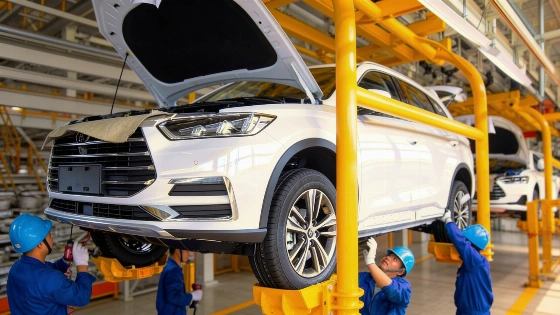
BYD is focusing on Spain and France for its next European factory, prioritizing the purchase and rapid upgrade of an existing site to accelerate production and stay ahead of competitors.
BYD has set a clear condition for its next European factory: the host country must offer an existing plant that can be quickly acquired and converted. This requirement has already eliminated Italy from consideration, leaving Spain and France as the frontrunners for the Chinese electric vehicle manufacturer’s second major site in the European Union.
Alfredo Altavilla, BYD’s special advisor for Europe, outlined the company’s approach directly: “We have to find something to buy now and refurbish it with relatively little money... quickly,” he told reporters in Turin. For BYD, speed is the priority. The company aims to avoid the delays of building a new facility and instead accelerate production by taking over a site that can be adapted swiftly. According to Reuters, Altavilla said a decision on the location is expected by the end of 2026, underscoring the urgency as competition and regulatory changes intensify in the EU.
BYD has already started early-stage production at its first European passenger car plant in Szeged, Hungary, with mass manufacturing planned for later in 2026.
This strategy is driven by more than convenience. With the EU imposing tariffs on electric vehicles built outside its borders, Chinese manufacturers are under pressure to establish local production. Industry reports note that the European Union has set a 10% base tariff on imported electric vehicles, plus an additional 17% compensatory duty specifically for BYD, making local manufacturing essential for competitiveness. Leapmotor has already chosen Spain, setting up in Villaverde, Madrid and Zaragoza. Geely is moving into Ford’s plant in Valencia. BYD also operates factories in Turkey and Hungary, but these alone do not meet its ambitions for the European market.
Altavilla identified Spain and France as the most promising options because they offer “a simpler situation” for acquisition and conversion. Italy, once in the running, is now a backup. The reason is straightforward: Stellantis, Italy’s only major automaker, is not selling any plants. “I can’t buy something that’s not for sale,” Altavilla said, highlighting the practical obstacle that has shifted BYD’s attention. As reported by Reuters and other automotive outlets, the focus on Spain and France is based on logistics and the readiness of available sites.
Altavilla, who joined BYD as an advisor in 2025 after roles at IVECO and FCA, also indicated that BYD’s plans extend beyond a single new plant. To comply with European regulations and meet future demand, BYD envisions “three assembly plants and one battery plant” across Europe. For now, the immediate objective is to secure a second assembly site within the EU, with the search focused on facilities that can be quickly repurposed. According to statements cited by Reuters, this multi-site approach is intended to help BYD meet local content requirements and anticipated market growth.
The EU's new trade barriers have accelerated the localization strategies of several Chinese automakers, with Leapmotor and Geely also acquiring or targeting existing plants in Spain and Valencia, respectively. This trend reflects a broader industry shift toward rapid adaptation to European regulatory and market pressures.
The competition is intense. Altavilla described a scenario where teams from various Chinese automakers are searching Europe for suitable factories, sometimes encountering each other in airport lounges as they pursue the same opportunities. The race is about more than location—it's about who can act fastest to secure a position in the market.
Spain’s emergence as a hub for Chinese electric vehicle investment is already visible. As previously reported, other Chinese brands are also targeting Spanish sites to speed up their European expansion. The trend is clear: existing infrastructure has become the most valuable asset in the electric vehicle sector.
BYD’s focus on acquiring and upgrading an operational plant marks a shift in how global automakers approach European manufacturing. Rather than building new facilities, the emphasis is now on speed, adaptability, and reducing risk. For Spain and France, the outcome is significant. The country that can provide the right facility stands to gain jobs, investment, and a central role in Europe’s electric vehicle transition. BYD’s message is clear: the future will favor those who can move quickly and make the most of existing resources.