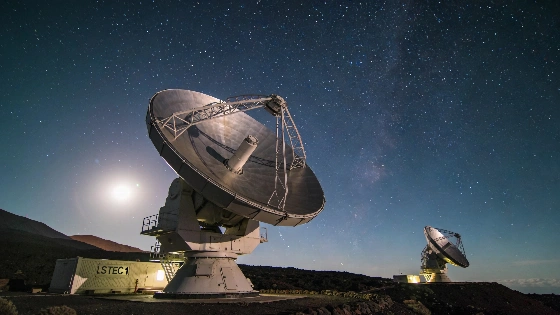
Two telescopes in La Palma have confirmed the detection of OP 313, the most distant blazar ever observed at very high gamma-ray energies. The signal, which began its journey 8 billion years ago, offers new insights into the universe’s intergalactic light and cosmic evolution.
In December 2023, a faint but extraordinary signal reached the telescopes LST-1 and MAGIC on the island of La Palma. What these instruments captured was not just another cosmic event, but the most distant blazar ever observed at very high gamma-ray energies—OP 313. According to a study published in August 2026, this detection marks a new milestone in high-energy astrophysics and opens a rare window into the universe’s distant past.
OP 313 is a type of active galactic nucleus powered by a supermassive black hole. Classified as a flat-spectrum radio quasar, it stands out for its intense luminosity and a jet of matter pointed almost directly at Earth, amplifying the radiation that reaches us. The object’s redshift, measured at z = 0.997, places it roughly 8 billion light-years away—making it the farthest blazar ever detected in this energy range. The previous record-holder, PKS 0346-27, sits just behind at z = 0.991.
Breakthrough Observation
The initial alert came after optical and high-energy signals suggested unusual activity from OP 313. LST-1 began targeted observations on December 10, 2023, quickly joined by the MAGIC telescopes. Over nine days, LST-1 collected about 15 hours of valuable data, with an additional five hours added in January 2024. By then, the blazar’s activity had diminished, and the gamma-ray signal faded below detection thresholds. This campaign confirmed OP 313 as only the tenth flat-spectrum radio quasar ever identified in very high-energy gamma rays.
Tracing the Journey of Gamma Rays
The gamma rays detected by the Canary Islands telescopes did not arrive unscathed. During their 8-billion-year journey, these photons interacted with the extragalactic background light (EBL)—a diffuse glow produced by all the stars and galaxies that have ever existed. Each collision with EBL photons could destroy a gamma photon, converting it into an electron and a positron, and gradually weakening the signal. By analyzing the loss of gamma photons at different energies, researchers were able to set new constraints on the density of the EBL, particularly in the 0.325 to 1.069 micrometer range, which is crucial for reconstructing the history of cosmic light.
The study combined data from LST-1, MAGIC, Fermi-LAT, and other observatories to refine these measurements. As Mireia Nievas Rosillo, one of the researchers, noted, each distant detection “opens a new window for studying the extragalactic background light.”
What Powered the Flare?
During the observed flare, the Fermi-LAT satellite recorded a burst of high-energy emission from OP 313 that was about 50 times stronger than its usual output. The most plausible explanation points to a dense population of electrons, accelerated to near light speed, streaming within a plasma jet from the vicinity of the black hole. These electrons collide with lower-energy photons, transferring energy through a process known as inverse Compton scattering. The models suggest a two-zone leptonic scenario, but the precise origin of the seed photons—whether from the accretion disk, broad-line region, or dust torus—remains uncertain. Multiple combinations can reproduce the observed spectrum, so further coordinated campaigns will be needed to clarify the mechanism.
Expanding the Gamma Horizon
The record-setting detection came while LST-1 was still in its commissioning phase. As the prototype for four planned large telescopes at the northern site of the Cherenkov Telescope Array Observatory (CTAO), LST-1 features a 23-meter mirror capable of capturing signals from energies as low as 20 gigaelectronvolts. The two MAGIC telescopes, each with 17-meter mirrors, provided stereoscopic confirmation and helped cover a broader energy range. This synergy allowed for more robust and independent measurements.
The full array of four LST telescopes is scheduled to be inaugurated in La Palma on October 15, 2026. Once operational, the expanded network will boost sensitivity to distant extragalactic sources and rapidly changing phenomena. Unlike visible events such as the 2027 solar eclipse, these gamma rays cannot be seen directly. Instead, Cherenkov telescopes detect the brief flashes produced when gamma radiation interacts with Earth’s atmosphere, enabling astronomers to track fast flares and search for even older or fainter sources.
As the field of gamma-ray astronomy advances, each new detection from the edge of the observable universe helps refine our understanding of cosmic evolution and the invisible light that fills intergalactic space.