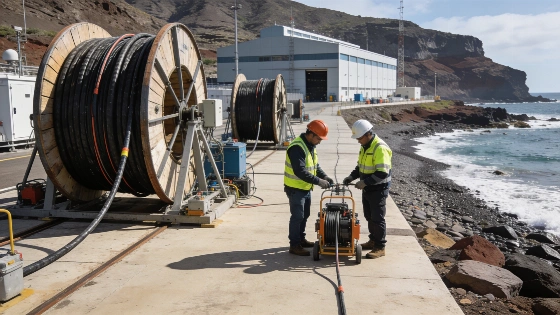
A new undersea fibre optic network will soon connect Gran Canaria, Lanzarote, Fuerteventura and Morocco, promising faster, more resilient digital links. The €47 million investment is set to transform communications between Europe and Africa, with completion expected by 2028.
Work is underway on a high-capacity undersea cable system that will connect the Canary Islands with Morocco, marking a significant step in digital infrastructure for both regions. The initiative, led by Canalink, involves two separate projects: the RING network linking Gran Canaria, Lanzarote and Fuerteventura, and a new branch extending to the Moroccan port of Tarfaya.
The RING project, valued at €33.98 million, will lay approximately 553 kilometres of fibre optic cable in a closed loop between the three eastern Canary Islands. This design, with two submarine routes running east and west, is intended to ensure uninterrupted service even if one segment is damaged—a notable upgrade from the more vulnerable linear systems currently in use. The official completion date for RING is set for September 2026.
Funding for RING includes €23 million from the European CEF Digital programme, reflecting the project's strategic importance for regional connectivity. The new infrastructure will replace ageing cables and provide the bandwidth needed for e-commerce, online education, telemedicine and the growing demand from data centres. Canalink has also launched a tender for a new submarine cable station in Pájara, Fuerteventura, with a three-month construction window and a budget of €481,339.50.
Direct Link to Africa
Separate from RING, the Morocco project will add a dedicated branch from the eastern cable to Tarfaya, Morocco, at a cost of €13.43 million. Of this, €7.46 million comes from CEF Digital. The connection is scheduled for completion by February 2028, according to Canalink's documentation.
This new route aims to create a direct, high-capacity digital corridor between Europe and Africa, reducing the risk of outages and diversifying Atlantic communications. The project requires international permits, bilateral coordination between Spain and Morocco, detailed seabed studies and careful selection of the coastal landing point. It is also designed to support the rising demand for digital services and 5G technologies across both continents.
Budget and Project Scope
Together, the RING and Morocco projects represent an official investment of €47.4 million. While some reports have cited a €49 million figure, Canalink's documents clarify that these are two distinct undertakings with separate timelines and funding sources. The higher estimate may reflect a broader budget perimeter not detailed in the available documentation.
Questions Over Western Sahara
Canalink's materials suggest that Morocco could eventually extend the cable further south toward Western Sahara. However, the official plans currently end at Tarfaya, with no confirmed extension, timeline, budget or permits for further expansion. Western Sahara remains on the United Nations list of non-self-governing territories, and a 2024 European Court of Justice ruling requires that any EU-Morocco agreements affecting the territory must respect the consent of the Sahrawi people. As such, any future extension would require careful legal and diplomatic consideration.
For the moment, the confirmed endpoint is Tarfaya, and there is no published plan for a southern extension. The legal implications for Spain are limited to the current route, and any further expansion would depend on new agreements and regulatory approvals.
As the Canary Islands prepare for this leap in digital connectivity, the region is set to benefit from more robust communications and new opportunities for economic and technological growth. The scale of the project echoes the kind of behind-the-scenes preparation and commitment seen in other demanding fields, such as the world of Spanish orchestras, where months of work and coordination are required for success, as highlighted in this recent feature on the realities of summer orchestras in Spain.