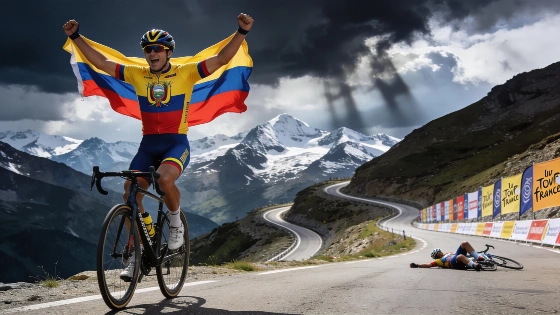
Richard Carapaz won the Tour de France’s queen stage at Alpe d’Huez after a chaotic finale, with Sepp Kuss crashing twice and Tadej Pogacar choosing to protect his teammate’s podium position. The penultimate day covered a punishing route of about 170 km, with more than 5,400 meters of climbing. Results recorded Carapaz’s winning time as 4:59:39. Remco Evenepoel finished 26 seconds back, with Kuss third, 31 seconds behind.
The decisive moment came on the descent toward Alpe d’Huez, just seven kilometers from the finish. Kuss had attacked solo on the Col de Sarenne and crested the final climb alone, but lost control on a technical section and crashed into roadside barriers. He quickly remounted, then fell again moments later, ending his hopes of a stage victory. Despite the crashes, Kuss finished within half a minute of Carapaz. The Ecuadorian had been chasing relentlessly since the early breakaway; he seized his chance and crossed the line alone.
The route’s major climbs, including Télégraphe and Galibier, then Croix de Fer and Sarenne, made the stage a severe test of climbing strength, descending skill and positioning. Associated Press coverage described the planned route as “brutal” and potentially “epic.” Earlier in the race, Carapaz had won stage 18 at Orcières-Merlette, attacking on the final climb in what the AP called a perfectly timed move. That victory established him as a major breakaway threat before the Alpe d’Huez finale.
Earlier, the stage’s breakaway included Juan Ayuso, Jai Hindley, Matteo Jorgenson, Ben Healy, Thymen Arensman and Mads Pedersen, alongside Kuss and Carapaz. The relentless pace on the Télégraphe-Galibier sequence soon split the group, leaving only the strongest riders in contention. Carapaz, already wearing the mountain classification jersey, attacked repeatedly and strengthened his position in the climbers’ contest.
Behind the leaders, Tadej Pogacar, secure in the yellow jersey, turned from personal ambitions to team strategy. Isaac del Toro was under pressure from Paul Seixas and Evenepoel in the podium battle, but Pogacar chose not to pursue Carapaz. He stayed with Del Toro to help protect his position. The stage results list Pogacar and Del Toro together, 1:05 behind Carapaz, consistent with the team’s focus on the general-classification battle instead of a separate chase for the stage win.
Kuss, visibly shaken and battered, finished after losing his chance to win and valuable time. His misfortune showed how unpredictable mountain racing can be: navigating descents and corners can matter as much as climbing strength. Carapaz’s victory came after a day of persistent aggression and tactical awareness, even as Kuss’s crashes changed the finale.
The Alpe d’Huez finish has a storied history in the Tour de France, often providing the setting for decisive moments and unexpected twists. In recent years, the climb has brought both triumph and heartbreak, as highlighted in coverage of Pogacar’s previous stage win on this iconic ascent. The 2026 edition added to the mountain’s reputation for drama, with the day’s events forming one of the race’s defining chapters.
The final standings put Pogacar first overall in 73:56:26, 6:26 ahead of Evenepoel; Carapaz finished eighth, 20 minutes behind the winner. Carapaz also won the mountains classification with 156 points. Pogacar scored 100, while Valentin Paret-Peintre finished with 99. After the Tour, Carapaz said, “I battled hard to win this jersey, it was a great fight,” adding, “It’s the best feeling to win it.” His result highlighted the separate prize in the mountains, even as Pogacar retained the overall lead.
Alpe d’Huez, with its 21 hairpin bends, ranks among cycling’s most recognizable climbs. Its gradients and tactical demands test endurance and nerve, while the approaches and descents reward careful positioning. Carapaz’s stage win and mountains title showed how individual ambition and team strategy can shape a final mountain battle, and how quickly a descent can change a race.