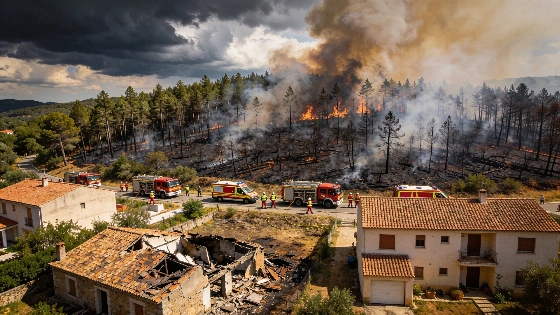
Residents in eight Girona municipalities can leave their homes after Catalan authorities lifted the lockdown following the stabilization of the wildfire that swept through Les Gavarres natural park. The fire scorched 2,300 hectares, forcing residents to stay indoors and restricting access to affected areas. People may now leave their homes, while access to properties inside the fire perimeter remains subject to police coordination.
Firefighters declared the blaze stabilized overnight but warned that the risk remained high because of soaring temperatures and the possibility of new outbreaks. Emergency teams continued to monitor the area, ready to respond to flare-ups. Jordi Marín, head of the Girona fire brigade, said restrictions remained in place for some properties inside the perimeter, with police coordinating access.
More than 500 personnel, including firefighters, the Military Emergency Unit (UME), volunteers from the Agrupació de Defensa Forestal (ADF) and local farmers, worked through the night to contain the flames. Ten people suffered minor injuries. The fire destroyed eight homes and partially damaged another eight, along with industrial buildings and vehicles.
Specialist teams were due to inspect the structural safety of affected buildings, particularly in the Cabanes residential area of Calonge i Sant Antoni and Vall Repós in Santa Cristina d’Aro. Aerial support included four water bombers and seven helicopters. Crews focused on the fire’s irregular right flank and isolated hotspots, where it was difficult to establish the boundary between burned and unburned land.
Officials feared that midday sea breezes and persistent heat could reignite the fire, push it deeper into the Les Gavarres massif and put as much as 30,000 hectares at risk. Road closures around the fire zone were expected to be lifted gradually. Authorities urged the public to stay away and avoid “fire tourism” so emergency vehicles could move freely. Speed restrictions were also expected on reopened roads to support response operations.
The wildfire came amid a difficult fire season in Catalonia. A regional assessment reported by L’Indépendant put the number of fires between June and September 2026 at about 450, with nearly 5,000 hectares burned across the region. Those seasonal totals provide broader context for the incident, which affected 2,300 hectares. Later local coverage of Les Gavarres described new green shoots, along with surviving holm oaks and pine trees, as signs of vegetation recovery after the fire.
This incident follows a series of wildfires in Catalonia in recent years, showing the region’s vulnerability during periods of extreme heat and drought. A previous major blaze near La Bisbal d'Empordà also led to widespread lockdowns and impressive firefighting challenges, as detailed in this earlier report on emergency measures in Les Gavarres. The latest fire highlights the need for coordinated emergency response and public cooperation during wildfire season in Spain.
Wildfires regularly threaten Mediterranean regions, particularly during summer, when high temperatures and dry conditions prevail. In Spain, climate change and land abandonment, along with shifting weather patterns, have increased the frequency and intensity of such incidents. The Les Gavarres fire shows how preventive measures and rapid response, supported by community awareness, can minimize damage and protect people and natural landscapes.