The Superior Court of Catalonia has refused to grant amnesty to Josep Maria Jové and Lluís Salvadó. Judges demand further answers from the EU Court before applying Spain’s new law. The case exposes ongoing legal uncertainty for top ERC officials.
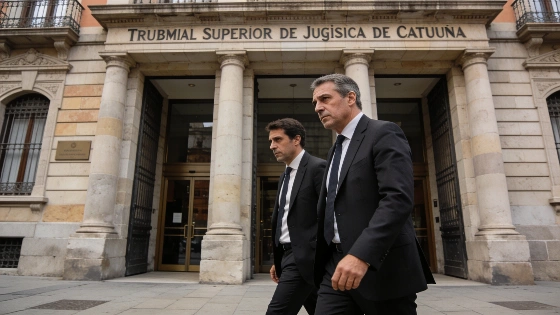
The Superior Court of Catalonia (TSJC) has put a stop to the amnesty process for two senior ERC figures, Josep Maria Jové and Lluís Salvadó. Both men, former high-ranking officials in the Catalan government and still influential within Esquerra Republicana de Catalunya, will not receive amnesty for now. The court’s decision shows that, even with Spain’s new amnesty law and a recent European Court of Justice ruling, some cases remain unresolved and contentious.
The TSJC is waiting for more specific answers from the European Court of Justice (TJUE) before moving forward. The main issue is whether the amnesty law can apply to cases involving alleged misuse of public funds and corruption. The judges say the July 16 ruling from the European court, which broadly supported Spain’s amnesty law, did not address all the legal questions raised in the Jové and Salvadó case. Because of this, the TSJC has formally denied their request for immediate amnesty, leaving their legal status uncertain.
On September 3, 2026, the TSJC explicitly refused immediate amnesty for Jové and Salvadó, maintaining its preliminary questions to the EU Court regarding the compatibility of amnesty with charges of misuse of public funds.
Jové, now president of ERC’s parliamentary group, and Salvadó, the party’s director general, are being prosecuted for malfeasance, disobedience, and embezzlement. The charges relate to their roles in organizing the 1-O referendum while working under Oriol Junqueras in the Department of Economy during the ‘procés’. Their lawyers argued that the European court’s recent decision should clear the way for amnesty, but the TSJC disagreed, saying the ruling did not resolve the specific doubts raised by the Catalan court.
The TSJC’s statement points out that the cases previously addressed by the European court are not the same as those facing Jové and Salvadó. The court says its own questions to the TJUE—focused on protecting public funds and anti-corruption rules—are still unanswered. Until those clarifications come, the amnesty process for these two ERC leaders is on hold.
Other figures involved in the ‘procés’ have seen their legal cases move forward. In late July, the Supreme Court granted amnesty to Meritxell Serret and several former members of the Catalan Parliament’s Mesa, all convicted of disobedience. Their cases advanced quickly after the European court’s decision, showing how the pace of amnesty decisions can vary widely.
The TSJC had already submitted a preliminary request to the EU Court back in 2024, specifically questioning whether amnesty could apply to cases involving 'malversación' (embezzlement or misuse of public funds). The court's current position is that the July 2026 EU ruling does not fully resolve these doubts, leaving the legal status of Jové and Salvadó uncertain until a direct response from Luxembourg is received.
This legal standoff is not unique. As reported earlier, Spain’s judiciary has often clashed with political authorities over the limits of judicial independence and how new laws are interpreted. The TSJC’s position in the Jové and Salvadó case highlights the courts’ determination to apply their own standards, even when national and European institutions have weighed in.
Spain’s amnesty law was meant to ease political tensions and resolve old legal cases from the Catalan independence push. But the TSJC’s refusal to proceed without more guidance from the EU shows how fragile legal consensus remains, and how much mistrust still exists between regional judges and lawmakers. For ERC, the outcome is clear: legal closure is still out of reach, and amnesty is far from guaranteed. The court’s decision keeps Jové and Salvadó in legal limbo and leaves the broader amnesty effort under close watch.