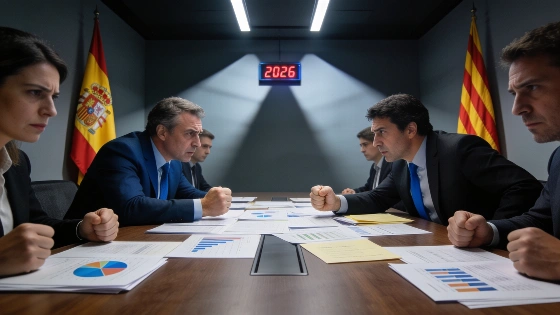
Catalonia insists on passing the new regional funding model by 2026. The government warns that any further delay could threaten budget plans and political alliances. The reform would bring €4.7 billion more annually to the region.
The Catalan government is pressing for the swift approval of a new regional financing model, warning that any further delay could jeopardize both its budgetary ambitions and political stability. Economy and Finance Minister Alícia Romero has accepted a short postponement of the crucial Consejo de Política Fiscal y Financiera (CPFF) meeting, but made clear that the reform must be passed in 2026 to take effect in 2027. This timeline is seen as essential for Catalonia to secure the largest and most expansive budget in its history, with an expected annual increase of €4.686 billion in funding.
Romero emphasized that while the government is willing to give the Partido Popular (PP) regions five more weeks to present their proposals, this extension cannot be used as a pretext to stall negotiations in Congress. She noted that the summer recess would have delayed any parliamentary process until September regardless, so the current pause does not fundamentally alter the legislative calendar. However, Romero insisted that the PP must clarify its position and present a concrete model, as the details of their approach remain unknown.
The reform is a cornerstone for President Salvador Illa’s administration, especially as it faces mounting pressure from public sector workers and ongoing discontent over housing access. The additional funds are expected to allow for a more expansive budget, with spending projected to rise by over 10%. At the same time, the new financing model is seen as a key bargaining chip to maintain the support of ERC, particularly ahead of upcoming municipal elections where the strength of the parliamentary alliance will be tested.
ERC leader Oriol Junqueras has taken a harder line, accusing PP-led regions of seeking the benefits of the reform without openly supporting it. Both Junqueras and Romero agree that the model must be approved in Congress before the end of the year to ensure it comes into force on January 1. However, the government will also need the backing of Junts deputies, who have expressed reservations about the current proposal from the Ministry of Finance.
Romero acknowledged that negotiations with the PP could alter the final figures, but argued that significant changes would require adjustments to core elements such as the adjusted population metric, which she considers unlikely. Any modifications agreed with the PP would also need to be discussed with Catalonia and the Canary Islands. The government’s stance reflects a broader skepticism among left-wing parties about the PP’s intentions, though recent shifts in the position of the Canary Islands may encourage more PP regions, like the Balearic Islands, to engage in talks.
Spain’s regional financing system has long been a source of political tension, with regions like Catalonia arguing that the current model does not reflect their economic weight or fiscal needs. The CPFF, which brings together the central government and regional representatives, is the main forum for negotiating these arrangements. The outcome of the current reform process will have significant implications not only for Catalonia’s finances but also for the broader balance of power between Spain’s regions and Madrid. The debate highlights the complex interplay between fiscal policy, regional autonomy, and national politics in Spain’s decentralized system.