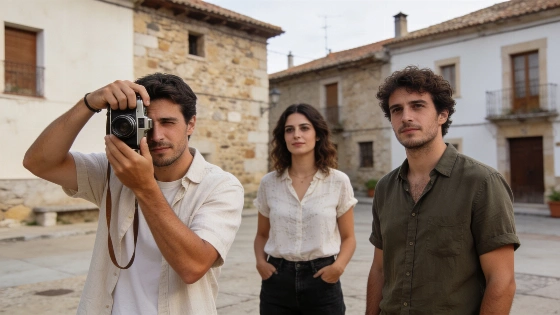
A 2009 gathering in Cervera de Pisuerga recreated a photograph Isla had made decades earlier. Her archive records a rural world in transition across more than 130,000 documents.
A 1975 interview with Isla, held by TVE and recently digitised, gives the documentary a record of her own account. In 2009, residents gathered in Cervera de Pisuerga’s main square to recreate a photograph she had made more than fifty years earlier. A new generation stood in for the people in the original. The scene appears in Piedad Isla revelada, a documentary for Imprescindibles, directed by Laura García Rojas and made by Juan Soria. Filming took place in Cervera and nearby villages such as Lores and Vidrieros. The crew also filmed in San Felices de Castillería.
Isla’s archive contains more than 130,000 documents on life in the Montaña Palentina, where she lived and worked. The collection includes negatives and other photographic materials. It is organised by assignment, with records also arranged by village and year. Digitisation, supported by European funding, was completed in 2005.
Isla started with a second-hand camera, taking wedding photographs for neighbours. She later photographed baptisms and communions. Identity cards were another part of her work.
Born on 6 September 1926 in Cervera de Pisuerga, Palencia, Isla opened her own photography studio there in 1953. The town then had about 2,000 residents. She kept working until retiring in 1992, travelling to dozens of villages first by bicycle and later on a Vespa. Her subjects included farm workers and miners. She also photographed shepherds, children and older residents, documenting local customs and religious ceremonies. Communal work known in the province as huebra featured in her images, alongside everyday life altered by rural depopulation.
She filmed on Super 8 as well as taking still photographs. Isla worked as a correspondent for EFE. Her reporting also appeared in El Norte de Castilla and Diario Palentino.
At home, Isla founded an ethnographic museum and collected objects connected with local culture and traditional ways of life. Her public work formed another part of her career. From 1972 to 1977, she was the first woman to serve as a councillor in Cervera de Pisuerga. She was also the town’s first deputy mayor. In the documentary’s previously unpublished interview, digitised by the TVE archive, she discusses her work in local government.
Several photographers assess Isla’s contribution in the film. Cristina García Rodero, the first Spanish photographer to join Magnum, recognises Isla’s role in opening doors for other women. Juan Manuel Castro Prieto, winner of the 2015 National Photography Award, points to the humanist quality of her work. Chema Conesa calls her a photography pioneer. Marisa Flórez and José Manuel Navia focus on the truth and documentary value of her images.
Recognition of the archive’s value began to grow after archaeologist Esteban Sáinz Vidal selected negatives at random from different years. He submitted them to Santander’s Centro de Documentación de la Imagen for an assessment of Isla’s work.
Isla’s Super 8 films captured traditions threatened by rural depopulation. They also record journeys to Japan and Indonesia. Her archive remains in Cervera de Pisuerga, at the ethnographic museum she founded.
The centenary is also marked by Las islas de Piedad, an RNE Audio podcast created and directed by journalist Helena Cerveto. It explores Isla through her photographs. Cerveto also considers the places Isla lived and the people who remember her. The documentary’s public presentation is timed to the centenary of Isla’s birth in 2026.