A police incident involving a Catalan estelada flag in Elche has reignited tensions. Independence groups see new momentum ahead of the September 11 Diada. Authorities and FC Barcelona face renewed scrutiny.
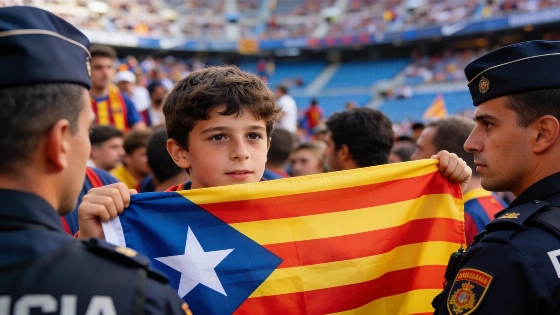
The Catalan independence movement, which has faced declining momentum in recent years, has been abruptly thrust back into the spotlight following a controversial police intervention at a football match in Elche. The incident, involving the forceful removal of a young fan displaying an estelada flag, has triggered widespread indignation among pro-independence groups and reignited debate over freedom of expression and police conduct in Spain.
The episode unfolded during Barcelona's LaLiga opener at Elche's Estadio Martínez Valero, where National Police attempted to identify a minor carrying the estelada. According to police, the situation escalated after chants against Spain, but video footage circulating online shows officers using force, including a visible elbow strike to the subdued youth. The Ministry of the Interior has since launched an internal investigation, while only one police union publicly defended the officers' actions.
Pro-independence parties such as Junts per Catalunya and Esquerra Republicana have highlighted both the disproportionate police response and the symbolic weight of the estelada in the incident. They argue that the police's approach infringed on freedom of expression, especially since Spanish law only restricts symbols inciting violence or terrorism, not the mere display of the estelada. Amnesty International has also criticized the police operation, while the rapid response from Interior Minister Fernando Grande-Marlaska aimed to contain the fallout.
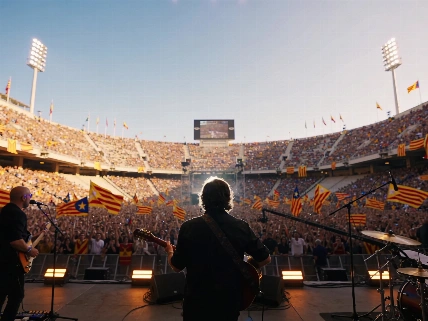
The controversy quickly spilled over into the sporting arena. At the following match in Camp Nou, thousands of estelada flags—10,000 distributed by the ANC—were waved in a coordinated show of defiance. This act overshadowed FC Barcelona's planned tribute to players from Spain's World Cup-winning squad, a move some independence supporters viewed as an attempt at 'españolización.' The club, caught between conflicting pressures, postponed the tribute and faced criticism for its handling of the situation, with President Joan Laporta initially referencing an 'exaltation of the estelada' before stepping back from any formal statement.
For independence organizations, the Elche incident has provided a rare opportunity to mobilize supporters ahead of the annual Diada on September 11. After years of internal divisions and declining turnout—exacerbated by government pardons for 'procés' leaders and the advance of the amnesty law—many see this as a chance to revive the movement's energy. However, the emergence of Aliança Catalana and ongoing disputes over participation in Diada events continue to complicate efforts to present a united front.
Organizers such as the ANC and Òmnium Cultural are preparing for a decentralized Diada, with events in Barcelona, Girona, and Amposta. The debate over whether to include the xenophobic party led by Sílvia Orriols remains unresolved, with current ANC leadership emphasizing a focus on social rather than political fronts and a commitment to human rights. This internal tension reflects broader challenges facing the independence movement as it seeks to regain relevance.
Recent polling by the Generalitat indicates that support for independence stands at 45%, with 51% opposed. The movement's ability to capitalize on the current wave of indignation remains uncertain, especially as the political climate in Catalonia has shifted toward dialogue and de-escalation under the governments of Pedro Sánchez and Salvador Illa. As noted in a recent analysis of Catalan political dynamics, internal divisions and external pressures continue to shape the region's future.
The estelada crisis has not only reignited debate over national symbols and police conduct but also exposed the fragility of the independence movement's unity. With the Diada approaching, all eyes are on whether this renewed momentum will translate into lasting political impact or fade amid ongoing fragmentation.
For context, the estelada is a symbol of Catalan independence, distinct from the official senyera. Its public display has often been a flashpoint in Spanish politics, especially at major sporting events. The annual Diada commemorates the fall of Barcelona in 1714 and has become a focal point for pro-independence demonstrations. The current controversy underscores the enduring sensitivity around regional identity and state authority in Spain, particularly as the country continues to navigate the legacy of the 2017 independence push and subsequent legal reforms.