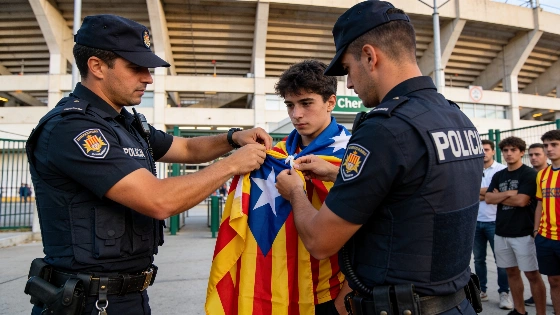
Police removed estelada flags and allegedly used force against a fan at Elche-Barça. Junts and ERC demand legal clarification and an investigation. The incident raises questions about freedom of expression at sporting events.
Political tension escalated after the Elche-Barça football match, as Junts per Catalunya and Esquerra Republicana called on the Spanish government to explain the actions of police who removed estelada flags from fans and allegedly struck a supporter displaying one. The incident, which took place during Barcelona's debut in Elche, was captured on video and widely shared on social media, fueling criticism of the police response.
Barcelona FC described the police intervention as excessive, stating that the detention of a fan lacked proportionality and proper justification. The club also defended the estelada as a legal symbol, emphasizing that its display does not violate current regulations. Junts per Catalunya announced plans to bring the matter before Congress, submitting formal questions to the Interior Ministry regarding the legal grounds for the flag removal and whether such actions are considered prohibited or punishable conduct under Spanish law.
Party leaders, including Míriam Nogueras and Carles Puigdemont, condemned the police's approach, with Puigdemont labeling the incident as an example of structural rejection of Catalan identity. Junts is seeking clarification on whether an internal investigation has been launched to identify the officers involved and whether any audiovisual evidence from the security operation has been preserved. The party also referenced the Law 19/2007, which restricts symbols only if they incite violence or terrorism, not for mere display.
Esquerra Republicana echoed these concerns, demanding an immediate investigation and a public explanation from Interior Minister Fernando Grande-Marlaska. ERC questioned the proportionality of the police operation and insisted that freedom of expression must be protected at all sporting events, regardless of location or context. The party stressed that rights and liberties should be upheld for everyone, in every circumstance.
The controversy comes amid ongoing debates about the role of police at public events in Spain. Similar disputes have arisen in other regions, such as Catalonia, where local authorities have considered measures to address public order and civil rights. For example, recent discussions about reintroducing tolls on the AP-7 motorway to manage congestion have highlighted the complex relationship between regional identity, public policy, and law enforcement. More details on these regional debates can be found in this analysis of Catalonia's approach to managing public spaces and regulations.
Barcelona won the match 5-0, but the focus quickly shifted from the result on the pitch to the broader implications for civil liberties and the legal boundaries of political expression at sporting events. The outcome of the parliamentary inquiries and any potential investigations may set important precedents for future matches and public gatherings across Spain. The debate also underscores the ongoing sensitivity around Catalan symbols and the balance between security measures and fundamental rights.
In Spain, the display of regional or political symbols at sports venues has often been a flashpoint for controversy. While national law generally permits such displays unless they promote violence or terrorism, enforcement can vary depending on local authorities and the specific context. The current case may prompt further scrutiny of police protocols and the legal framework governing freedom of expression in public spaces, especially as political tensions remain high in several autonomous communities.