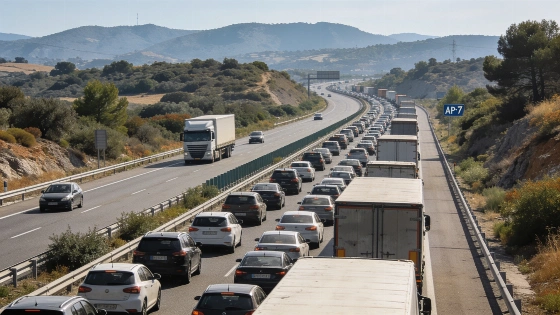
Catalonia may reintroduce tolls on the AP-7 to tackle heavy congestion and frequent accidents. Authorities plan to review options this autumn. A new working group will assess strategies for the region’s busiest motorway.
The Generalitat is weighing the possibility of reinstating tolls on the AP-7, one of Catalonia’s main highways, as a response to persistent congestion and a high accident rate. The issue is now under active discussion, with Interior Minister Núria Parlon confirming that a dedicated working group will be formed this autumn to evaluate potential solutions. The AP-7, which lost its tolls in August 2021, has since seen a surge in traffic, prompting renewed debate about whether the removal was the right move.
Parlon explained that the upcoming working group will bring together representatives from all departments involved in mobility and AP-7 management. The group’s mandate is to identify effective strategies to reduce both traffic jams and accidents. Among the options on the table is the controversial idea of bringing back tolls, a measure that has divided opinion since President Salvador Illa raised the topic in the Catalan Parliament on July 1. Illa called for a collective reflection on the decision to eliminate tolls, suggesting that the region may have acted too hastily.
While the toll debate continues, the Servei Català de Trànsit (SCT) is already rolling out a ten-point action plan to improve safety and traffic flow on the AP-7. Some measures are already in place, while others will be introduced in the coming months. Notably, a new mobile app is in development to provide real-time voice alerts to drivers about accidents and traffic jams, as well as suggest alternative routes. The app is expected to launch this autumn.
In addition, the SCT has begun testing a variable speed system powered by artificial intelligence across 150 kilometers of the AP-7, between Maçanet de la Selva and El Vendrell. This technology aims to adapt speed limits dynamically based on traffic conditions. The same stretch is also the focus of an AI-driven accident prediction system, which is now in advanced stages of development, according to Parlon.
In the Terres de l’Ebre region, where the AP-7 narrows to two lanes and accident rates are particularly high, authorities are installing variable speed signage. This complements earlier steps such as banning truck overtaking in certain sections. Traffic police and the Mossos d’Esquadra have also stepped up large-scale inspections of heavy vehicles, checking maintenance, technical inspections, and tachographs. Speed enforcement has been reinforced with six new radar units, bringing the total to ten along the 344-kilometer route.
Despite these efforts, Parlon acknowledged that the current measures alone will not fully resolve the AP-7’s challenges. Major infrastructure upgrades, including a planned expansion to three lanes in the southern section, are still pending approval and will take time to implement. The situation on the AP-7 reflects broader transport and safety concerns in Catalonia, where authorities are under pressure to balance mobility, safety, and public opinion.
For context, Catalonia has faced a series of infrastructure and safety challenges in recent years, from severe weather events to economic pressures on public services. For example, during recent storms, emergency services responded to widespread damage in Barcelona province, as reported in coverage of the Inuncat pre-alert. The ongoing debate over AP-7 tolls highlights the complex trade-offs involved in managing the region’s vital transport arteries.
The AP-7 is a critical corridor for both local commuters and long-distance travelers, linking key cities and supporting economic activity across Catalonia. Any decision to reintroduce tolls would have significant implications for daily mobility, logistics, and regional finances. As the working group prepares to meet this autumn, residents and businesses alike are watching closely for signs of what the future holds for one of Spain’s busiest highways.