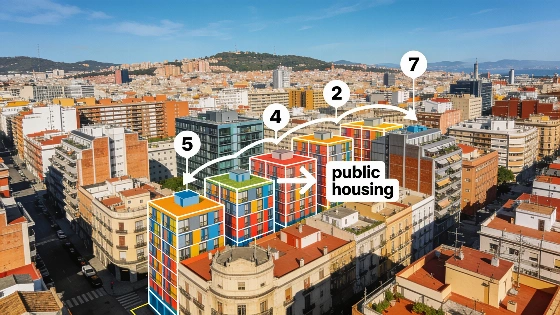
Catalonia’s government has used pre-emptive purchase rights to acquire nearly 9,000 public housing units in a decade. This approach now accounts for a quarter of all protected homes managed by the region.
In Catalonia, the right of pre-emptive purchase—known as tanteo y retracto—has become a central tool for expanding public housing. Over the past ten years, the Generalitat and associated organizations have acquired 8,859 protected flats through this mechanism, according to a study by KSNET using data from the Agencia Catalana de la Vivienda (ACH). This method now accounts for one in four public housing units managed by the regional administration.
The system allows the government to buy properties entering the market by matching the offered price and terms. Initially limited to homes from mortgage foreclosures, the scope has since widened. Between 2015 and 2025, the Generalitat received nearly 250,000 notifications of homes for sale, inspected almost 30,000, and ultimately purchased 8,859—about 3.6% of all notified properties.
Financially, the approach has proven efficient. The average acquisition price per flat was €65,000, less than half the €150,000 needed to build a new protected home. This cost advantage has helped offset a sharp decline in new public housing construction: only 16,388 new units were delivered in the same period, with annual completions sometimes dropping to just 700—far below the 8,600 seen during the housing boom, according to Idescat.
Most purchases were concentrated in the province of Barcelona, with the city itself and Terrassa leading in volume. Salt ranked third, reflecting a local policy to reclaim homes lost to investment funds and banks after more than 1,000 properties changed hands through foreclosures. Municipalities accounted for 15% of acquisitions, and third-sector organizations for another 15%. Foundations and NGOs focused their efforts in the Tierras del Ebro, notably in Deltebre and Amposta.
The typical acquired flat measures 65 square meters and has two bedrooms. After a slow start, systematic use of the pre-emptive purchase right began in 2018, peaking in 2025 with 1,304 units bought. While this strategy has allowed the Generalitat to expand its public housing stock more quickly and at lower cost, it has also created challenges due to the scattered nature of the properties.
For context, Spain’s public housing sector has historically lagged behind other European countries in both volume and affordability. The use of tanteo y retracto reflects a broader trend among Spanish regions to seek alternative ways to increase affordable housing amid limited new construction and rising market prices. The Catalan model may influence similar policies elsewhere as authorities look for cost-effective solutions to housing shortages.