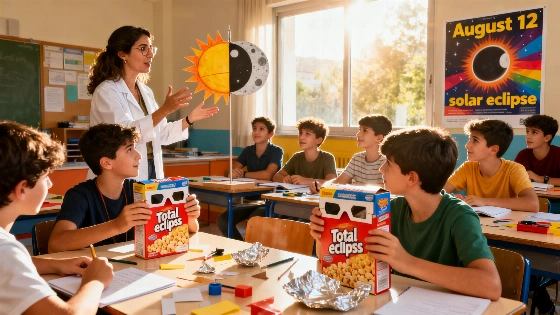
Catalonia is rolling out a new program to teach students about the upcoming total solar eclipse. Scientists are visiting schools to explain the phenomenon and inspire interest in science. The initiative targets students in vulnerable communities.
With a total solar eclipse set to cross much of Spain on August 12, Catalonia has launched a targeted educational campaign to ensure students understand the significance of this rare event. The program, called Eclipsadas, is sending 25 trained scientists into classrooms to explain the science behind the eclipse and encourage scientific curiosity among 12-year-olds, especially in schools with high levels of social vulnerability.
At the Instituto Escuela Maria Miret in L’Hospitalet de Llobregat, students recently received a visit from a researcher who broke down the astronomical mechanics of the eclipse. For many, this was their first direct contact with a scientific expert. Teachers at the school note that while the eclipse is a hot topic among students, most lack access to reliable information or opportunities to engage with professionals in the field.
The Eclipsadas initiative, developed by the Generalitat de Cataluña in partnership with the Fundación Catalana de la Investigación, aims to reach around 2,700 students across 44 public and private schools. The program is part of the broader institutional campaign Cataluña mira al cielo and will extend into summer camps in July, as the eclipse itself will occur during the school holidays.
To support teachers less familiar with astronomy, the Ministry of Education has also introduced a free online course focused on the trio of eclipses expected in 2026, 2027, and 2028. The course, titled El Sol y el trío de eclipses 2026-2027-2028, offers video modules and classroom activities to help educators bring the topic to life for their students.
Local governments, research centers, and community organizations are also organizing workshops and talks to prepare the public for the event. The main goals are to explain why the eclipse is happening, highlight the rarity of three consecutive eclipses of different types, and provide safety advice for viewing. Ariadna Gómez del Pulgar, a researcher from the Instituto de Física de Altas Energías de Cataluña, emphasizes the importance of teaching students how to observe the eclipse safely, including the use of certified glasses and homemade projectors.
Beyond the science, Eclipsadas is designed to spark interest in scientific careers, particularly among girls. All participating speakers are women scientists, reflecting the program’s commitment to gender balance in STEM fields. Many students at the L’Hospitalet school come from families with limited exposure to science, making these visits a rare opportunity to connect with real-life researchers.
During the sessions, students learn not only about the eclipse but also how to build simple devices to observe it indirectly. Using cereal boxes, white paper, and aluminum foil, they create projectors to safely view the phenomenon. For some, the event is a chance to plan family outings, while others face barriers such as lack of transport or resources. The program aims to make the experience accessible to all, regardless of background.
According to public data, the last total solar eclipse visible from Catalonia occurred in 1905. The upcoming event is part of a sequence of three eclipses over three years, an unprecedented occurrence in the region. Solar eclipses happen somewhere on Earth roughly every 18 months, but total eclipses visible from the same location are extremely rare. The initiative reflects a broader push in Spain to use major scientific events as opportunities to promote STEM education and address social inequalities in access to science.