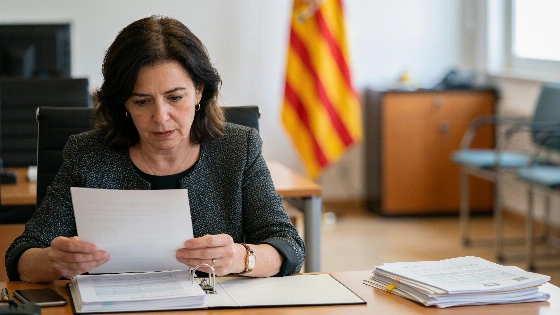
Llum Rodríguez, the first woman to lead Catalonia’s audit office, highlights gaps in planning and oversight. She urges more transparency and warns that many public resources lack proper follow-up. The Parliament holds the key to change.
Llum Rodríguez, recently appointed as the first female head of the Sindicatura de Comptes in Catalonia, has raised concerns about the region’s approach to managing public resources. In her first month in office, Rodríguez has emphasized that transparency and independent oversight are essential for a healthy democracy, but she warns that Catalonia still struggles with a lack of planning and a weak culture of control.
Rodríguez, a jurist and political scientist from Ourense, was unanimously chosen by the Parliament after her predecessor stepped down. She insists that her gender should not be newsworthy, but acknowledges that women still face barriers to leadership roles. Her main priority is to safeguard the independence of the audit institution, which serves the Parliament and is responsible for scrutinizing the use of public funds.
According to Rodríguez, the Sindicatura’s reports are based on international auditing standards and are reviewed by the audited entities, who can submit objections before publication. However, she notes that the technical nature of these reports often makes them difficult for the public to understand. To address this, the office now produces summaries and quick-read documents, as well as infographics and videos for some cases.
One of the main challenges, Rodríguez says, is that the Sindicatura lacks the power to enforce its recommendations. The Parliament is responsible for holding the executive to account, and while the audit office can issue follow-up reports, it relies on the trust that ministries and agencies will implement suggested improvements. In practice, changes often depend on the willingness of those being audited.
Rodríguez identifies public procurement, personnel management, and the awarding of subsidies as the areas most vulnerable to misuse of funds. She points out that the current subsidy system is comprehensive but overly complex, creating administrative burdens that can hinder effective oversight. Simplifying procedures could make controls more agile and effective.
On the issue of public-private partnerships, Rodríguez argues that collaboration is necessary, especially for smaller administrations that lack resources. The real problem, she says, lies in the insufficient controls imposed by the public sector. Private partners often have greater technical capacity than the administration itself, making rigorous oversight even more important. She recommends thorough analysis of contract terms and robust post-award monitoring, noting that a lack of resources and a weak culture of control often lead to excessive profits for contractors and prices above market value.
Rodríguez also highlights a broader issue: a tendency in Catalonia and across Spain to prioritize immediate action over careful planning. She contrasts this with northern European countries, where compliance and long-term planning are more deeply rooted. While she does not consider the Catalan administration to be non-compliant, she acknowledges that endemic deficits in planning are widespread.
Her comments echo ongoing debates about the effectiveness of Catalonia’s public sector. For example, recent criticism of the regional government’s handling of infrastructure and services, as discussed in a recent analysis of opposition claims against the PSC-led administration, highlights the persistent challenges in ensuring accountability and efficient use of public money.
For context, the Sindicatura de Comptes is Catalonia’s supreme audit institution, tasked with evaluating the legality, efficiency, and effectiveness of public spending. Its reports are a key tool for parliamentary oversight, but without binding enforcement powers, their impact depends on political will. The debate over how to strengthen these mechanisms continues to shape the region’s approach to governance and public trust.