Catalonia’s push for renewables is stalled by over 12,000 objections. More than 1,300 come from local governments. The Plater plan’s future is now uncertain as calls grow for its suspension.
The Generalitat’s ambitious Plater plan to accelerate renewable energy in Catalonia has run into unprecedented resistance from local authorities. More than 12,000 formal objections have been filed, with over 1,300 coming directly from municipalities, provincial councils, and regional bodies. This surge in opposition highlights deep territorial concerns and signals a major challenge for the government’s strategy to expand solar and wind power across the region.
The Xarxa per una Transició Energètica Justa, a coalition of environmental, agricultural, and municipal groups, has demanded that the Plater process be halted. They argue that the plan was launched without first determining Catalonia’s actual energy needs, the best locations for new installations, or which areas should be protected. The group also calls for a freeze on all renewable projects over 5 megawatts—currently overseen by the Ministry for Ecological Transition—until a new regional framework is approved.
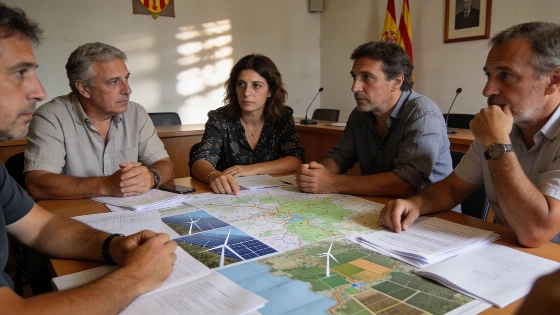
Officials from the Department of Territory defend the plan, stating it is based on 141 overlapping information maps and aims to set clear guidelines for each municipality. They claim the Plater could reduce the total area prioritized for renewables by up to 35% and ensure that no municipality is required to allocate more than 5% of its land for green energy projects. The government insists that the current phase is designed to gather local input, with a second round of objections expected to extend the process for at least another year.
Much of the opposition has been coordinated by the Xarxa per una Transició Energètica Justa, which provided templates for individuals and organizations to submit objections. According to their data, around 11,800 people used these templates, a figure that does not fully align with the Generalitat’s official count. During a press conference, representatives highlighted that some of the areas marked for solar or wind development include essential municipal infrastructure or valuable agricultural land, such as centuries-old olive groves. The Department of Territory maintains that the objection process is precisely intended to protect such spaces, but local fears remain strong.
One of the most striking examples comes from the Solsonès region, where all 17 municipalities have formally opposed the Plater in the initial objection round. This area, along with Alt Empordà and Anoia, is designated as a prime zone for wind and solar expansion, despite Solsonès and Alt Empordà currently lacking any operational wind turbines. The plan requires every municipality to contribute a minimum quota of renewable energy production, with specific targets such as 2,000 MW of solar in La Noguera and a focus on wind in regions like Ribera d’Ebre, Baix Ebre, Conca de Barberà, Segrià, Garrigues, and Anoia.
Since its introduction, the government has argued that Plater will help resolve territorial disputes by distributing renewable generation more evenly and addressing long-standing grievances over energy infrastructure. Currently, 56.7% of Catalonia’s electricity comes from nuclear plants, both located in southern Tarragona. The debate over Plater reflects broader tensions in Spain over how to balance the urgent need for clean energy with local interests and land use concerns. In other regions, similar disputes have influenced political alliances and policy decisions, as seen when regional governments faced legal pressure over the relocation of unaccompanied migrant minors from Ceuta, a situation detailed in recent coverage of coalition dynamics and legal challenges.
For context, Spain’s national targets require a rapid increase in renewable capacity by 2030, but progress has been uneven across regions. Catalonia’s current renewable output is only about 20% of what will be needed to meet these goals. The outcome of the Plater debate will likely set a precedent for how other autonomous communities approach the expansion of green energy while managing local resistance and environmental priorities.