Palacio de Liria brings Cayetana Fitz-James Stuart back into focus. More than 200 objects connect her private life with the palace she helped rebuild in an exhibition running until 31 January 2027.
Only the four façades of Palacio de Liria survived the Spanish Civil War intact. Inside, the building was almost completely destroyed. The Casa de Alba also lost 50% of its library and almost 90% of its archives.
That damage now forms the central thread of an exhibition in Madrid. Called 'Cayetana. Grande de España', the show marks the centenary of Cayetana Fitz-James Stuart's birth and runs until 31 January 2027. It brings together more than 200 artworks, photographs, letters, documents, dresses and personal objects.
RTVE reports that the exhibition's strongest story is the recovery of the palace itself. For Cayetana, the rebuilding was more than a family duty. She saw it as her most valued contribution to the history of the house.
During the Civil War, part of the Casa de Alba’s cultural heritage was evacuated first to Valencia and later to Geneva, following a route comparable to the evacuation of works from the Museo del Prado.
The exhibition gains force from that history.
Fundación Casa del Alba organised the show for the centenary of Cayetana's birth and the 70th anniversary of the rebuilding of Palacio de Liria. It occupies six rooms and uses a different layout from the earlier presentation at Dueñas in Seville.
The curatorial team remains the same. Eugenia Martínez de Irujo and Cristina Carrillo de Albornoz oversee both versions. The Madrid presentation was launched across 30 September and 1 October 2026. It is scheduled to remain open through 31 January 2027.
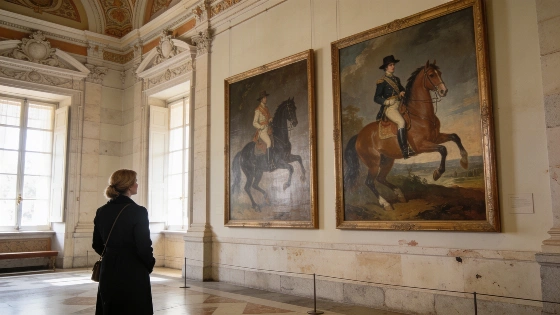
The selection follows themes rather than a strict timeline. Visitors first see two equestrian paintings by Zuloaga together for the first time. One shows Cayetana riding her pony Tommy in 1930. A small Mickey Mouse detail appears in the painting. The other depicts her as a teenager in country clothes on a white horse.
Recent reporting places the completion of the palace’s reconstruction in 1956. The project was initiated by Jacobo Fitz-James Stuart, XVII Duke of Alba, and Cayetana and her husband Luis Martínez de Irujo carried it forward after his death.
From there, the show moves toward the person behind the title. Family photographs cover her childhood, youth, father, godfather and wedding. Other images place her with people she admired, such as Montserrat Caballé and Sophia Loren.
They also show her during trips, with her dogs and with her five children. That material is full of spontaneity.
Eugenia Martínez de Irujo said the family had struggled to sort through the enormous volume of photographs and documents. She called public affection for her mother the greatest legacy Cayetana left behind.
Another section presents Cayetana as a patron of the arts and a creative figure in her own right. It includes sculptures by Benlliure, a wax-crayon drawing she made as a child, flamenco dresses and photographs by Juan Gyenes and Richard Avedon.
Her letters to Jacqueline Kennedy widen the story beyond Spain. One displayed object is a watercolour Kennedy painted of a room at Dueñas during her stay there.
The exhibition also follows Cayetana's role in the growth and care of the Casa de Alba collections. It adds detail to an earlier Madrid report without reducing her to public appearances or aristocratic ceremony.
The reconstruction room provides the clearest historical record. Jacobo Fitz-James Stuart, the XVII Duke of Alba, decided in 1942 to rebuild Liria after completing his time as Spain's ambassador in London. He contacted the British architect Edward Luytens. Construction began in 1952.
Recent accounts place the end of the work in 1956. Jacobo died in 1953. Cayetana then continued the project with her husband, Luis Martínez de Irujo.
Plans, drawings and photographs record the process. The work covered the building's interiors as well as its architecture. It also required the reorganisation of the collections and a search for furniture and decorative objects across several European countries.
A seven-minute film shows the palace before, during and after the reconstruction. Cayetana explains why she considered Liria a legacy for Madrid.
The final room turns to style. Dresses by Givenchy, Tony Benítez, Lucchino, Hermanas Morales and Dior show how Cayetana became an international fashion reference while keeping her attachment to tradition.
Assouline published 'Cayetana, la duquesa de Alba: Arte, Aristocracia y el alma de España' as the exhibition catalogue.
The show works best when the famous duchess steps back. The builder, collector, artist and mother come forward instead.
Palacio de Liria is not presented as a fixed aristocratic residence. Its rooms record a long recovery. The exhibition connects private evidence with public history and makes Cayetana's story inseparable from the building she helped restore.