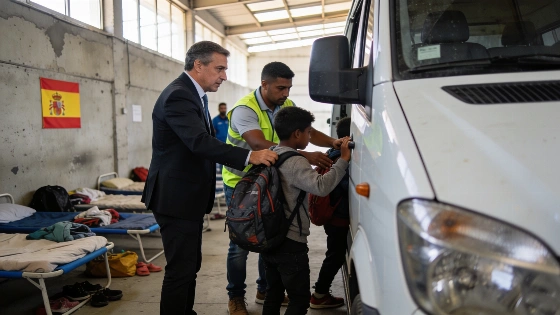
Spain prepares to transfer migrant children from Ceuta to other regions. Minister Sira Rego warns against political exploitation. The government accelerates emergency measures amid mounting pressure.
The Spanish government is moving quickly to address the surge of unaccompanied migrant minors in Ceuta, with Minister of Youth and Children Sira Rego announcing that transfers to other autonomous communities will begin within weeks. Rego, who arrived in Ceuta on Thursday, described the situation as one of the most severe migration crises Spain has faced in recent years. She sharply criticized the Partido Popular (PP) and Vox for what she called their “propagandistic and electoral” use of the crisis, insisting that the law obliges all regions to participate in the relocation process.
Authorities in Ceuta are still working to determine the exact number of minors who have entered the city, as many children remain unregistered or hidden. While some local reports have suggested figures as high as 5,000 to 6,000, Rego stated that the real number is likely lower, but refrained from providing an estimate until the identification process is complete. The profiles of the minors are diverse, with a significant presence of children as young as 12, including both boys and girls, which complicates the response and requires tailored support services.
Efforts are underway to conduct age determination tests in Ceuta itself, aiming to expedite the process and avoid unnecessary transfers for very young children. The first priority, according to Rego, is family reunification, which involves detailed interviews and coordination with countries of origin, particularly Morocco. For those who cannot be reunited, integration into Spain’s child protection system is planned, with all legal guarantees in place. The government has allocated €25 million to support emergency accommodation and is sending a ministry team to Ceuta to implement protocols and coordinate with regional authorities.
Images circulating of minors being escorted by soldiers to the border have raised concerns about potential rights violations. Rego emphasized that all necessary measures are being taken to prevent abuses and that any documented incidents will be reviewed in accordance with the law. The minister also confirmed that the relocation of asylum-seeking minors will follow the same timeline as other children, with the government managing their cases directly.
Political tensions have escalated as Vox refuses to accept relocated minors, while the PP says it will comply with the law. Rego dismissed the possibility of regions refusing to participate, stating that legal obligations are clear and must be respected. She called the use of the crisis for political gain “absolutely regrettable,” especially given the human cost and the more than 140 reported deaths linked to recent migration events.
Most autonomous communities reportedly have available capacity to receive minors, and a sectoral commission has been convened to accelerate procedures. Rego urged citizens to rely on accurate information, noting that Spain processed 2,000 migrant child cases last year without major incidents. She highlighted the humanitarian aspect, pointing out that many children come from conflict zones such as Sudan and Palestine, as well as Morocco.
The causes of the sudden influx remain under investigation, with Rego pointing to the broader failure of the European Union’s migration model, which relies on externalizing border management to third countries with differing interests. Cooperation with Morocco on child protection is handled through judicial and ministerial channels, but Rego questioned the wisdom of entrusting migration policy to external partners whose priorities may not align with Spain’s.
Debate continues over Morocco’s role as a partner, especially as some political groups, including Sumar and Vox, advocate for excluding Morocco from organizing the 2030 World Cup alongside Spain and Portugal. Rego expressed support for her party’s position, arguing that participation in international events should require a minimum standard of human rights.
For additional context on the political standoff between regional governments and the central administration over the relocation of minors from Ceuta, see this analysis of how coalition dynamics are being tested: Ceuta's surge in unaccompanied minors strains regional agreements.
Spain’s approach to unaccompanied migrant minors is shaped by both national and EU law, requiring solidarity among regions and adherence to child protection standards. The current crisis in Ceuta highlights ongoing challenges in managing migration flows at the EU’s southern border, the limits of external cooperation, and the political pressures that arise when humanitarian emergencies intersect with electoral interests. As the government accelerates transfers and support measures, the effectiveness of these responses will be closely watched in the coming weeks.