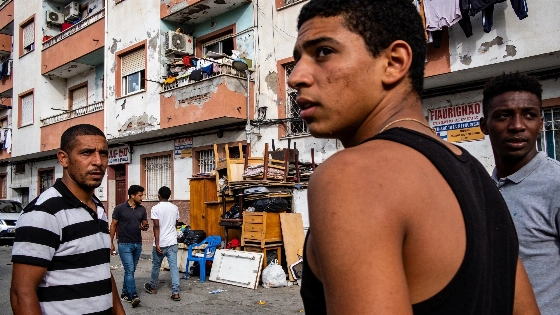
Ceuta is grappling with a severe migration crisis as poverty and unemployment soar. The influx of thousands of migrants is testing the city’s fragile social fabric and deepening divides in its poorest neighborhoods.
The recent arrival of around 80,000 migrants in Ceuta at the end of July has brought the city’s chronic social and economic problems into sharp focus. Even before this unprecedented influx, Ceuta already stood out for its high poverty rates, unemployment, and educational challenges, making it one of Spain’s most vulnerable territories.
According to official data, Ceuta’s GDP per capita is €23,070—over €9,500 below the national average and nearly €22,000 less than Madrid. The proportion of residents at risk of poverty has reached 37%, almost double the Spanish average of 19.5%. Eurostat places Ceuta and Melilla among the five European regions with the highest rates of vulnerable populations, alongside areas in southern Italy and French Guiana.
Unemployment remains a critical issue. Ceuta’s jobless rate stands at 22.4%, more than twice the national figure. Among those under 25, unemployment soars to 47.5%. The city’s young population, with an average age under 40, faces additional hurdles in education. The latest OECD PISA report shows Ceuta and Melilla lagging behind all Spanish regions, with results comparable to Mexico in mathematics, science, and reading.
Social exclusion is widespread. A December 2025 report from Fundación Foessa, linked to Cáritas, highlights that 28.5% of Ceuta’s population is socially excluded, compared to 19.3% in Spain. Severe exclusion affects 15.8%—almost double the national rate—impacting about 13,000 people. Housing problems are acute: nearly 60% of renters are at risk of poverty, and over 21,000 residents live in overcrowded or substandard conditions. The report also notes that families seeking social assistance often encounter fragmented and under-resourced support systems.
Inequality is particularly stark in Ceuta. The Gini index, which measures income disparity, is close to 40% in the city, compared to 31.2% nationally. Exclusion rates among foreign nationals reach 39%, double that of Spanish citizens. Muslim households are especially affected, with 44% experiencing exclusion, far above the city’s average. Half of all foreign-born residents are unemployed. In neighborhoods like El Príncipe, early school dropout rates can exceed 50%, despite the citywide average being similar to the rest of Spain.
The migration crisis has intensified these challenges. Many new arrivals have settled in the city’s most disadvantaged districts, further straining local economies and social cohesion. Business activity in these areas has declined, and hotel bookings have dropped. There are concerns that public resources may be diverted from existing vulnerable groups to address the immediate needs of migrants, potentially fueling political tensions.
Local organizations, such as Cáritas, are struggling to support both long-term residents and newcomers. The director of the Observatorio de Ceuta y Melilla warns that persistent inequality could undermine not only social stability but also Spain’s sovereignty over the enclave, as external pressures from Morocco continue.
Economists argue that the crisis could be an opportunity for Ceuta and Melilla to seek new economic arrangements with the EU, reducing their dependence on Morocco and integrating more residents into the formal economy. The closure of tolerated cross-border trade before the pandemic has already hit many families hard, and further instability could increase the city’s vulnerability.
Ceuta’s situation is unique within Spain and Europe. Its combination of high poverty, unemployment, and social exclusion, now compounded by a large-scale migration event, presents a complex challenge for local authorities and residents. The city’s future stability may depend on targeted social investment, improved coordination of aid, and broader economic reforms to address deep-rooted inequalities.
Ceuta and Melilla are Spanish autonomous cities located on the northern coast of Africa, bordering Morocco. Their special status and geographic position have long made them focal points for migration and diplomatic tensions. The recent crisis has highlighted the urgent need for sustainable solutions to support both local populations and new arrivals, while maintaining social cohesion and economic viability.